
Albanese's convenient crisis
Albanese is framing a foundational principle of prosperity as a policy failure because it makes a convenient origin story for the intervention he already wanted.


In the wake of the 2008 financial crisis, Barack Obama's Chief of Staff, Rahm Emanuel, said:
"You never want a serious crisis to go to waste. And what I mean by that is an opportunity to do things that you think you could not do before."
It's a lesson that Australia's Prime Minister, Anthony Albanese, appears to have taken on board: at today's National Press Club, he will tell the audience that the "free market" mindset of past decades left Australia dangerously exposed to the Iranian oil shock. The same mindset, he says, "dared manufacturing and industry to go offshore", and assumed "there would always be someone else, somewhere else, who would sell us what we needed cheaper than we could make it ourselves".
Last I checked, the free market never "dared" anyone. The free market just means using prices to communicate relative scarcity and the system of profit and loss to provide feedback. If Australian producers can't generate a return from an activity, then continuing to do that activity wastes resources.
Albanese is framing a foundational principle of prosperity as a policy failure because it makes a convenient origin story for the intervention he already wanted. A Future Made in Australia, the National Reconstruction Fund, smelter bailouts, the Whyalla rescue: he has been building the case for industrial policy, also known as subsidising inefficiency at the expense of Australia's more productive sectors, since his first term. The oil crisis is simply a convenient excuse for him to accelerate what he had already planned to do.
The free market isn't the reason why Australia is dependent on imports for fuel. According to a 2013 economics committee report, Australian refineries were already importing around 80% of their crude oil back then. They were relatively small (at least compared to Asian competitors), simple operations buying crude at a premium and shipping it long distances, with high labour costs, no economies of scale, and ever-increasing compliance costs from tighter fuel specifications and environmental regulations.
Subsidising refineries without a domestic source of oil and a competitive regulatory regime is just expensive theatre, creating the appearance of security while leaving taxpayers on the hook. It was Australian politicians who dismantled the foundations of viability in the first place by effectively banning onshore shale, blocking the domestic feedstock that might have kept refineries viable.
In the US, where the shale revolution gave Gulf Coast refineries access to abundant cheap crude, oil production has more than doubled since 2000. Meanwhile, Australia's has fallen by roughly 60%.
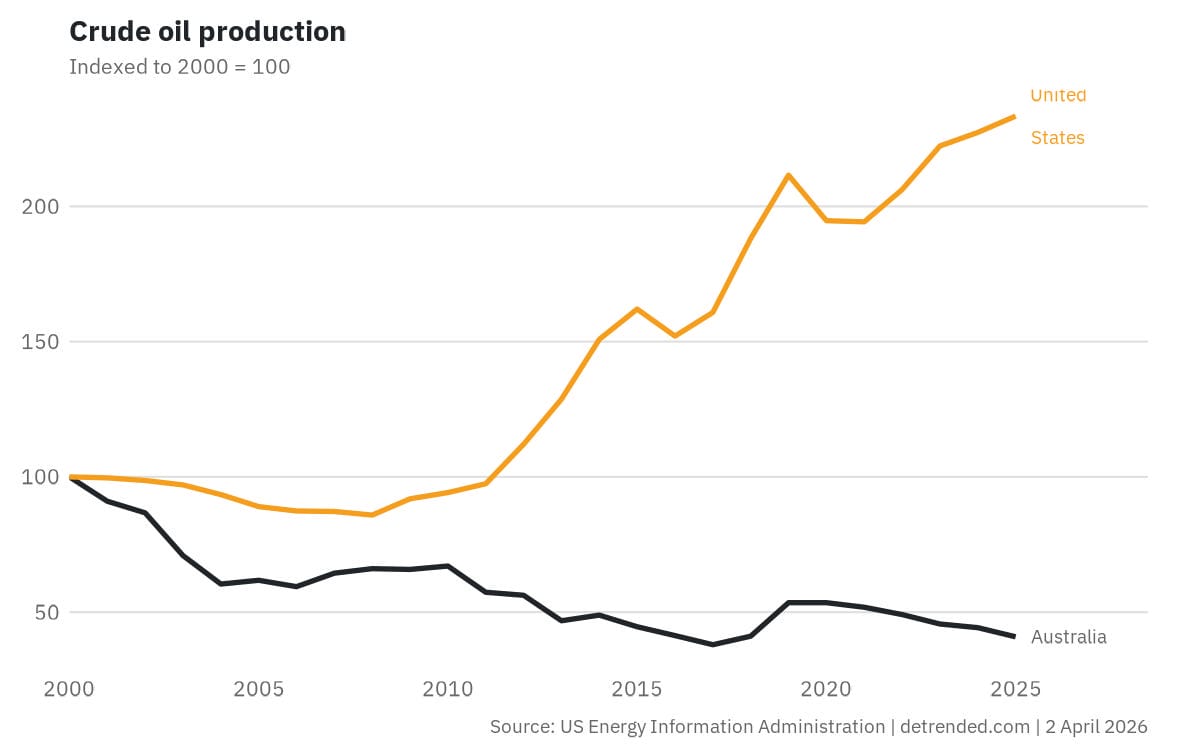
The genuine failures that left Australia exposed were government decisions, not market ones. Storing fuel reserves in the US under an IEA arrangement rather than building domestic stockholdings was a political choice. Running down the energy grid – and banning nuclear – was the result of political choice and regulatory dysfunction across multiple levels of government. Government failure is what created the mess that Albo now conveniently feels the need to attribute to the free market, and more government involvement in the economy without addressing why it failed in the first place will only make Australia more vulnerable in the future.


