
Another bump on the tariff rollercoaster
The US Supreme court may have struck down Trump's tariffs, but don't expect them to go away.


I'm back from a week in Japan along with what seemed like half of Australia. With the yen close to 30-year lows and plenty of mountains and snow, it really has become the premier ski spot for Aussies – although I did hear plenty of Chinese, European, and North American accents, too.
But boy did I ever miss an eventful week! The US Supreme court declared Trump's use of emergency powers to impose tariffs to be unlawful, only for the Tariff Man™ to respond by using Section 122 of the Trade Act to set universal tariffs to 10% for 150 days, only to hike that to the maximum 15% the next day. When that expires, Trump will need to convince Congress to support him or come up with another option to achieve similar ends, such as country-specific Section 301 investigations to drum up dubious charges of "discriminatory" trading practices.
That's assuming he makes it to 150 days. Section 122 was written during a time when the US had a fixed exchange rate, so the dubious intent of that passage means Trump will almost certainly face further legal challenges.
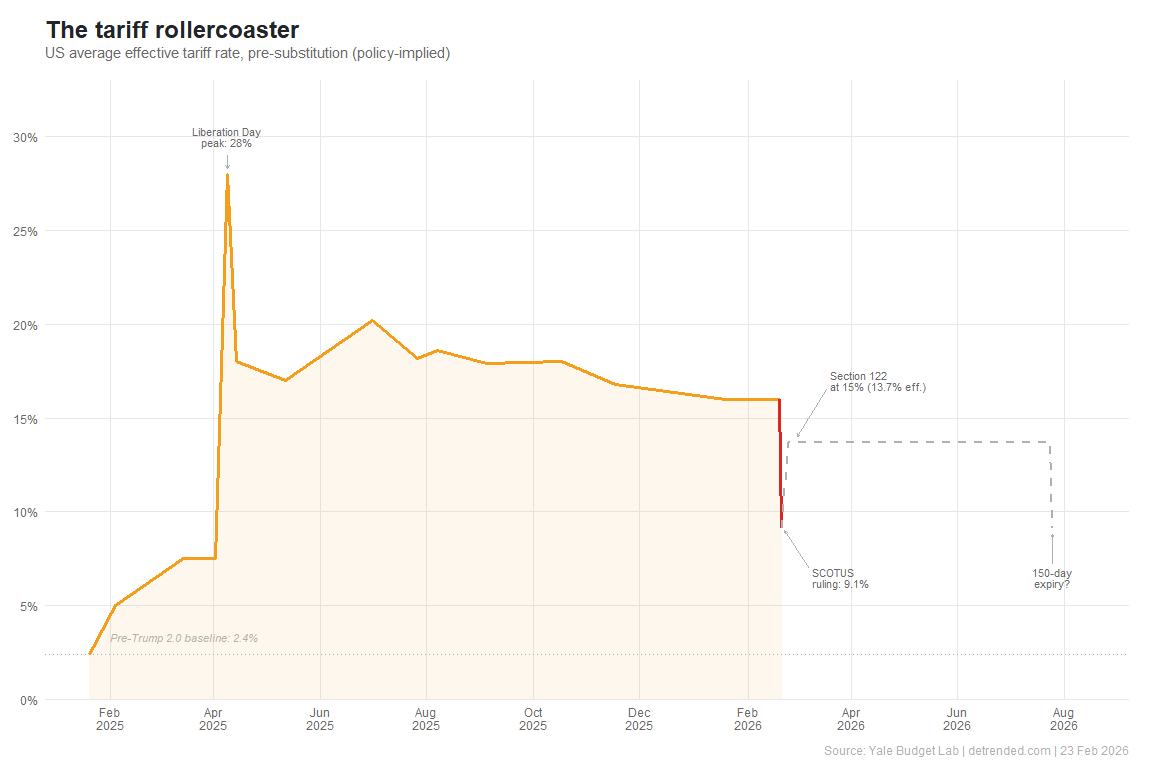
Despite the small drop in the US average effective tariff rate even after Trump's response, it's all exhausting and no doubt highly disruptive for businesses, who at this point must be considering simply whacking a 25% surcharge on anything going to the US and calling it a day; at least that would give them and their customers some certainty!
And for what, exactly? To effectively raise taxes on American households by something like US$1,500 a year, only to give it back to them in a dividend cheque? Tariffs reduce both imports and exports and so are an ineffective means at reducing the US trade deficit, which is "determined by macroeconomic forces" unrelated to things like tariffs and subsidies. Not that Trump or those in his administration care what the economic literature shows.
Trump will face mid-term elections in November, and while it's generally considered to be a favourable one for the Republicans, prediction markets still reckon – with 85% confidence – that at least the House will flip to the Democrats. That's not the end of the world for Trump; he'd have another group to blame for any failures, and while he would lose control of the legislative agenda, he's certainly no stranger to causing chaos through the executive branch.
Still, the Supreme court's decision was a win for institutions and the rule of law over volatile executive discretion. The S&P500 was up 0.7% on Friday and Trump waited for markets to close before announcing his response. But it was such an obvious, telegraphed response that it was almost entirely priced in: futures suggest markets have already moved on, with the S&P trading flat from Friday's close.


