
Canada's new path
Mark Carney's Davos speech signalled a new path for Canada. Trump's response is vindicating it.


At Davos last week, Canada's Prime Minister Mark Carney gave perhaps the most important speech of his political career, outlining what he called "principled and pragmatic" engagement in a world where great powers "have begun using economic integration as weapons, tariffs as leverage, financial infrastructure as coercion":
"We knew the story of the international rules-based order was partially false - that the strongest would exempt themselves when convenient. The trade rules were enforced asymmetrically. And we knew that international law applied with varying rigour depending on the identity of the accused or the victim."
Looking past the fact that Canada has a history of conveniently exempting itself from the rules-based order when dealing with economically smaller countries like New Zealand, the speech signalled a new path: Canada will reduce its dependence on the US.
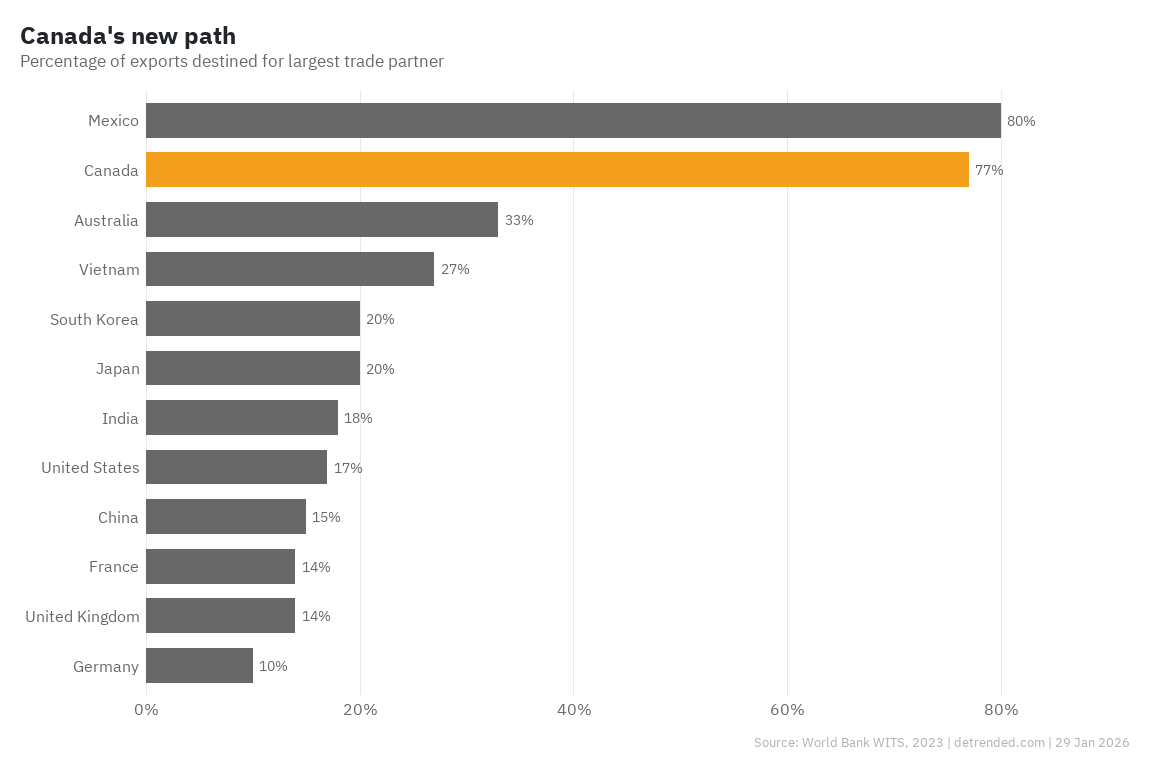
In pure economic terms, there's nothing 'wrong' with the above picture. It makes perfect sense to trade heavily with your land-border neighbour, especially when they happen to be the world's largest economy. But for a country that's being repeatedly lectured by Trump about becoming "the 51st state", there's also an obvious vulnerability.
Carney is trying to change that calculus. In just six months, Canada has struck a dozen trade and security deals across four continents, most recently with China and India, the world's two most populous countries.
Canadians won't necessarily be made worse off because of this effort to diversify. There's a difference between using command and control to direct exchange (e.g. 'industrial policy'), and simply signing deals with other countries to open their markets to Canadians, and vice versa. The former by definition allocates resources to less-efficient uses; the latter removes barriers that were preventing entrepreneurs from discovering opportunities outside of the USMCA.
So, assuming Carney isn't pivoting from free trade towards a large-scale, zero-sum strategic paradigm, Canadians should do just fine.
But the problem for Canada is it takes time for that to happen. Investments have been sunk, and forming new supply chains is costly. In the meantime, you have an erratic US President with three years left in his term who, within a day of Canada's deal with China, expressed his magnanimity and then unrepentant anger, threatening 100% tariffs on all Canadian goods.
The irony that Trump may not appreciate is that his response is vindicating Carney's decision to diversify, and he's slowly making protectionist Canada freer: the fact that Canadians will soon be able to buy high-quality, affordable Chinese EVs only exists because of Trump! Another consequence is he's pushing Canada and many other countries towards China, "giving Beijing an opening it didn't have before".
If Trump is playing 3D chess, let alone 4D chess, then he's doing it badly.


