
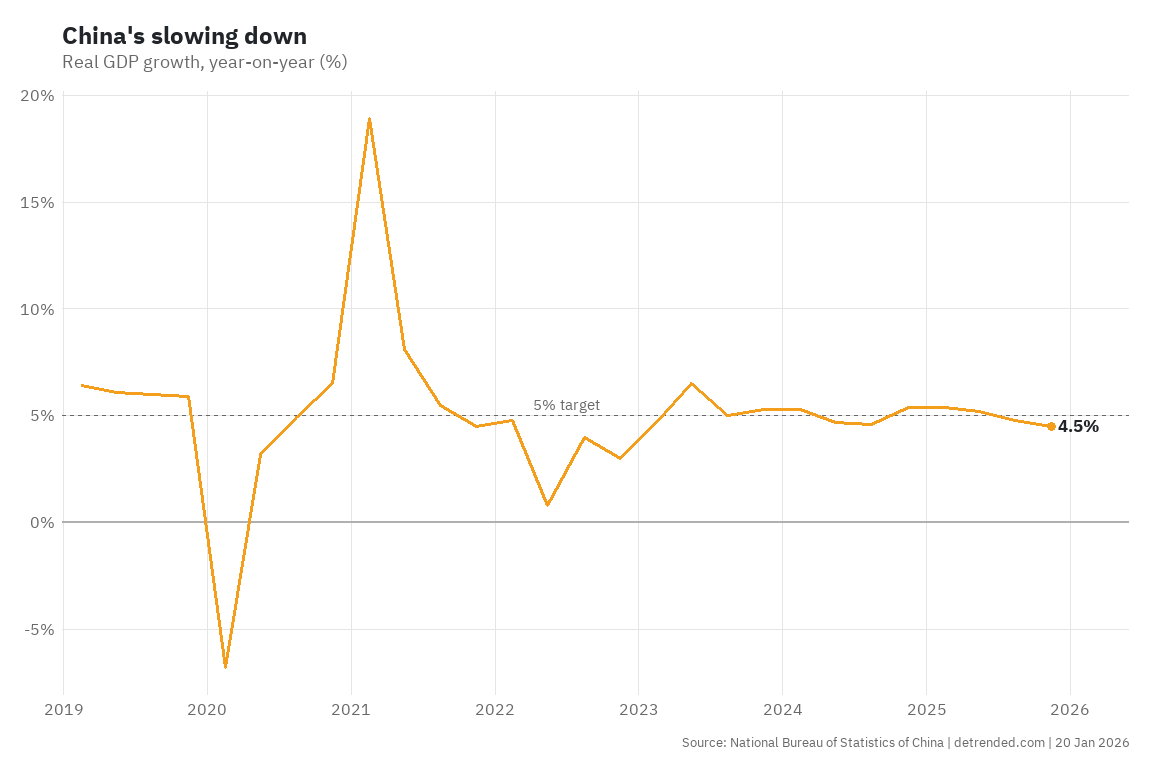
China's slowing down
China's real GDP grew 4.5% in Q4, its slowest pace in three years. But the details are worse than the headline.


China's economy grew 4.5% y/y in the December quarter of 2025, continuing a post-pandemic run of slowing growth. While full-year growth – surprise! – hit the 5% target, the devil is in the composition (to the extent that can be trusted, either).
Specifically, net exports contributed nearly a third of 2025's GDP growth, with the trade surplus hitting a record US$1.2 trillion. That's not a sign of strength: when Chinese households aren't buying what the country is producing, the output has to go somewhere. That's a win for foreign consumers but not great for most Chinese citizens, who are effectively subsidising overseas consumption at their expense.
The pay-off? Xi Jinping gets to boast about dominating "future industries", through "new productive forces", which is basically just old-school industrial policy with Chinese characteristics.
Yes, Beijing's industrial policy has delivered some genuine wins. Its EVs are dominating everywhere they're allowed to be sold (they're good—I drive one). Just about every battery sold these days is Chinese, as are the solar panels that are helping the world move away from coal. But China's productivity is poor, and for every BYD there are a dozen unprofitable automakers propped up by subsidies.
That's because those resources came from somewhere, i.e. have been misallocated. Chinese households are still relatively poor, with real GDP per capita only around 30% that of the US. Consumption remains under 40% of GDP, versus around 60% globally. Part of the reason for that can be traced to the last time the government picked winners at scale – property and infrastructure – creating a multi-year drag that's still weighing on the economy and repressing the Chinese consumer.
The risk is China's simply following the same model in different sectors: subsidise production, export the surplus, and hope external demand holds up—a bet that's getting riskier as parts of the world (not just Trump) turn protectionist. If it doesn't pay off in a big way, then China may stay stuck in middle-income for many decades to come.


