
Free public transport and a puppy
If you wanted to ease pressure on fuel prices, free public transport would be near the bottom of the list.

I hope everyone had a nice relaxing Easter and managed to avoid spending too much on fuel. Thankfully some of Australia's brilliant state politicians, in all their wisdom, decided that a great way to ease the pain at the bowser would be to make public transport fare free. From last Tuesday, Victorians have been riding trains, trams and buses for free. The scheme runs all of April, at an estimated cost of $70 million – what's several tens of millions when you're hundreds of billions in debt, right? Not wanting to miss a trick, Liberal-led Tasmania followed suit with free buses and ferries through to June.
The motivation for the free fares wasn't to reduce emissions, tackle road congestion, or increase patronage. No, it was "to ease pressure on fuel prices".
Sounds good, except that if that's your goal then making public transport fare-free is one of the worst and most expensive ways to achieve that goal!
Hear me out. If higher fuel prices were stinging, then drivers would already be switching to trains and buses, and many probably already have. But the remaining drivers are what economists call price inelastic: they won't switch because they can't. It could be because they're a plumber who needs to drive their van around town; a construction worker who drives to their site; or a big shot city lawyer who won't give up their BMW no matter what fuel costs. Regardless of why, they generally won't switch, even if fare prices are zero.
So, what does making the fare zero do? Mostly it attracts people who were walking, cycling, or not travelling at all. The marginal driver who did switch — the person teetering between car and train — now faces a more crowded service, which might just keep them on the road. It's also a regressive policy: your average public transport commuter earns more than car commuters, so slicing their fares to zero mostly just hands cash to CBD professionals who were already on the train. The people under pressure from higher fuel prices tend to be in outer suburbs and regional towns where the buses are infrequent, or have to drive to locations other than the city for work.
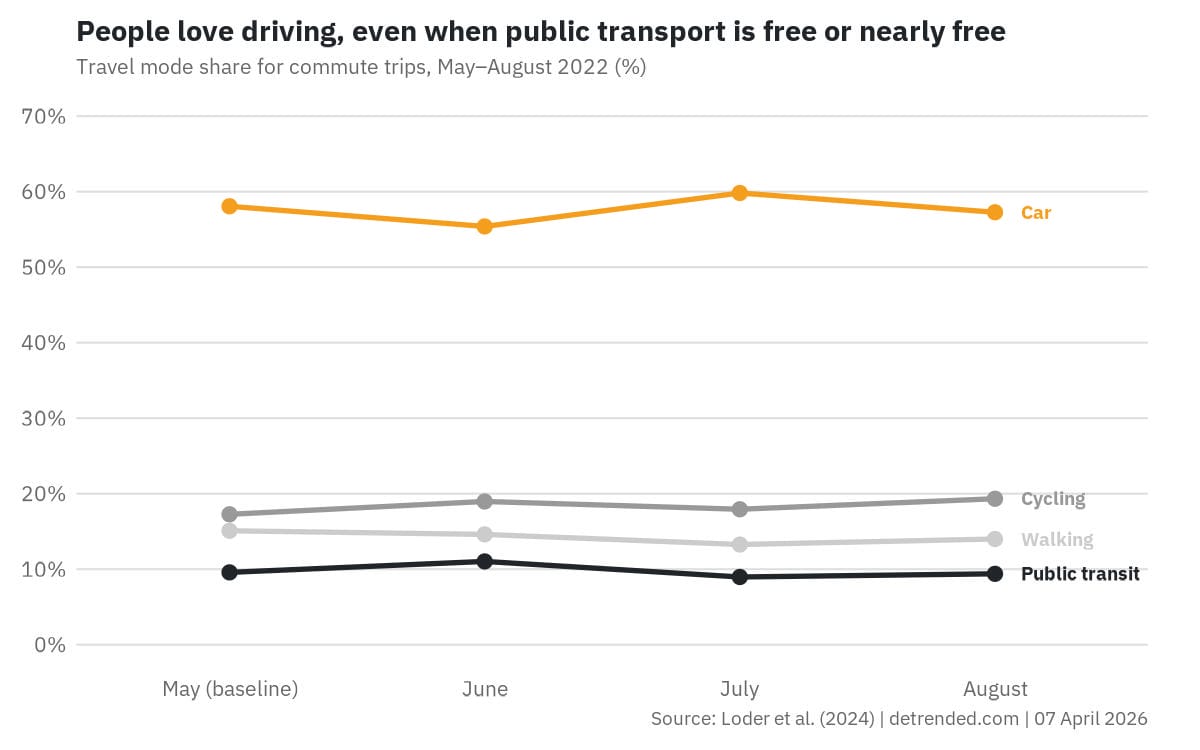
Australia isn't the first country to run this experiment. Germany's 9-Euro-Ticket in the summer of 2022 made public transport nearly free nationwide for three months in response to the Ukraine war. What happened? Car mode share went from 58% in the baseline month to 55% in June, then bounced back to 60% in July. Public transport peaked at 11%, up from 10%. Only a paltry 4.4% of car drivers switched to public transport when the ticket launched, with the vast majority electing to keep driving. The researchers concluded that the intervention "was not sufficient to achieve a modal shift from car to public transport for commuter trips".
A separate randomised controlled trial in Santiago found zero impact on car trips. And an older study that looked at various European cities that made public transport permanently fare-free found a similar pattern: public transport patronage surged but the new riders overwhelmingly came from walking, cycling, or were entirely induced trips. The effect on car traffic was marginal and typically disappeared within a few years of background traffic growth.
Thankfully, at least one state politician demonstrated some common sense. When asked if South Australia would follow Victoria, Treasurer Tom Koutsantonis responded:
"Yes, it would be lovely to give everyone free public transport and free car parking and a puppy."
He noted that 90% of his state's public transport costs are already subsidised. Going from 90% to 100% is an expensive way to do almost nothing "to ease pressure on fuel prices"!
But don't tell Victoria, where feel-good policy seems to trump reality far too often. I only hope Premier Allan doesn't get whiff of Koutsantonis' puppy idea and decide to make it part of her November re-election campaign, but given where politics is at these days nothing would surprise me.


