
How much fuel does Australia really have?
Australia's fuel reserves are thin, but they aren't the reason you're paying more at the pump.


I don't know what's going to happen with Iran and the Strait of Hormuz, which remains mostly closed to maritime traffic. I see a few possible scenarios:
- Trump chickens out, declares the "military operation" a success, walks away and the Strait reopens, perhaps with Iran collecting a toll in exchange for not shooting at ships.
- The US puts boots on the ground, seizing Kharg Island and attempting to reopen the Strait by force.
- The US and Iran strike some kind of deal, allowing for the Strait to reopen in some form while the two sides continue to "work" on their differences.
- We get a long, drawn-out conflict with no resolution and the Strait remains effectively closed for most of 2026.
The trillion dollar question for markets is timing. There could be a 'resolution' tonight, next week, or next year. For what it's worth, prediction markets currently put the odds of the Strait returning to normal by 1 July at around 45%.
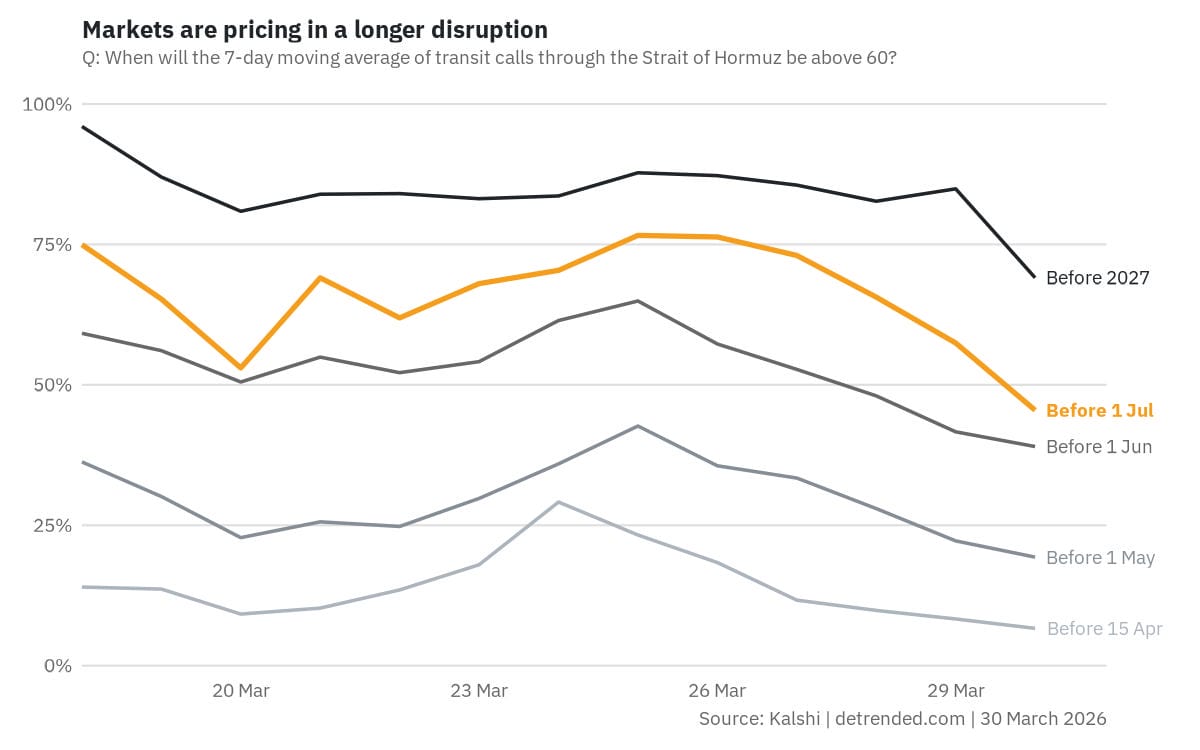
But while the pundits argue over missiles, the real anxiety in Australia is domestic fuel reserves. Yes, they're bad. Worst in the developed world, in fact. But they're also largely irrelevant for the current crisis because it's a partial supply shock, not a complete blockade.
Here's some basic maths. If Australia has 30 days worth of fuel, and 10% of global supply has been cut (the Strait of Hormuz is only around 20% of global oil supply, and something like half of that has already found alternative ways to escape or can be substituted for something else), that means those 30 days of reserves can cover the shortfall for more like 300 days, even without changes in consumption. The 30 days would only be relevant if there was a complete, sustained blockade of all supply routes, and that's just not what's happening today.
In reality, consumption patterns do change as people respond to incentives: higher prices are the market rationing demand, encouraging substitution, and pulling in supply from wherever it can be found. Australia is a relatively wealthy nation, so it's in suppliers' interest to continue sending cargoes here. Australia also exports plenty of important goods itself – e.g. food, LNG, coal – which provide significant leverage should fuel-exporting partners attempt to prioritise other markets. The governments of Australia and Singapore just signed a supply agreement last week, something that should have been formalised years ago.
So, in the short run Australia has plenty of fuel to get through this crisis in its current form. In the longer run, Australia probably does need to think a bit harder about energy security. Oil is priced globally, so Australia could extract every drop of its known reserves and pump prices would be roughly where they are today. But if there was a complete blockade of fuel, having some kind of insurance policy could certainly be handy. The real question is does it make sense to spend $20 billion-plus on fuel storage infrastructure, or perpetually subsidise domestic refineries? Doing so would raise the price of fuel in normal times, but ensure supply in the event of extreme tail risk events.
But that's not the situation Australia faces today; it's a different debate, about a different problem, with a different price tag and different probability attached. Conflating the two produces bad analysis and worse policy. For the shock we're actually in, the solution is high prices and strategic partnerships. Today's decision to halve the fuel excise is precisely the wrong one, as I made clear last week.


