
Oil is already being rationed
The biggest risk for Australia isn't the oil shock itself but that the urge to "do something" worsens the situation before the crisis is resolved.


Oil is now very expensive, which almost everyone is experiencing first hand via the price of petrol or diesel every time they fill up their car.
That creates two major problems. The first is that, as a supply shock, the Iran war-induced oil price spike will reduce economic activity. That raises the risks of a recession, job losses, and a decline in living standards. If the RBA tries to offset the real effects of the supply shock by keeping monetary policy too loose, stagflation (stagnation + inflation) is also a very real possibility.
The second is that Australia has been naughty in terms of meeting its International Energy Agency (IEA) obligations. Not since 2012 has the Australian government met the minimum fuel reserve requirements of 90 days worth of net imports. Basically, Australia kept growing and importing more fuel but at some point made the decision not to invest the billions needed to build the storage or purchase the forward contracts needed to remain compliant.
If Australia runs out of fuel altogether then a recession will be the least of its worries!
It's too late now, but should the Australian government have permanently raised the fuel price via a levy to pay for more reserves? I'm not so sure; according to Energy Minister Chris Bowen, it turns out that Australia's petrol stockpiles have "gone up a little bit" to 38 days' worth since the start of March, while diesel and jet fuel supplies are still at 30 days.
That suggests that supply is still flowing and oil is already being rationed. Every time someone decides not to drive because petrol is $2.50 a litre, that's rationing. Every time a commuter takes the train instead of driving, or a desk jockey works from home, that's rationing. The price mechanism is already doing the job of securing Australian fuel stocks, silently and efficiently, without a single bureaucrat making a single decision. Sky-high prices also ensure that every cargo worth diverting to Australia does get diverted, and that every refinery will run flat out.
What bothers me is that politicians don't appear to understand that process. Energy Minister Bowen is publicly musing about the "quite remarkable powers" available to him under the Liquid Fuel Emergency Act 1984. NSW is war-gaming emergency powers to ration and divert fuel. Treasurer Chalmers has sicced the competition watchdog (ACCC) on fuel retailers for passing through wholesale costs too quickly. One Nation wants to cut fuel excise by 50%. And Teal Allegra Spender is calling for a windfall profits tax of at least 50% on oil and gas companies, as I discussed last week here.
Every one of those ideas would make the problem worse.
Start with rationing. As New Zealand Initiative chief economist Eric Crampton recently wrote, the mere warning that rationing might happen encourages people to fill up their jerry cans today. It's self-fulfilling: the announcement creates the hoarding that makes rationing look necessary.
Then there's the ACCC circus. Retailers are passing through costs in line with wholesale prices, which is exactly what you'd expect when everyone can see Brent trading above US$100. If retailers expect to be investigated for charging market-clearing prices, they'll hold back supply to avoid the political heat. You get queues and dry pumps, not lower prices.
As for One Nation's proposed excise cut, that would effectively subsidise demand during a supply shortage and is perhaps the worst idea of the lot. Cutting the excise by 26 cents a litre means more consumption and a faster depletion of reserves.
High prices help allocate scarce fuel to its highest-value uses, attract new supply, and encourage conservation. Rationing, excise cuts, ACCC threats, and windfall taxes all undermine at least one of those functions.
The good news is this probably won't last long enough for any of those bad ideas to be implemented. Over the weekend Trump gave Iran 48 hours to reopen the Strait of Hormuz or he would "obliterate" its power grid. Whether that's a genuine threat or an off-ramp dressed up as an ultimatum, it's clear that recent moves in prediction markets are stressing him out.
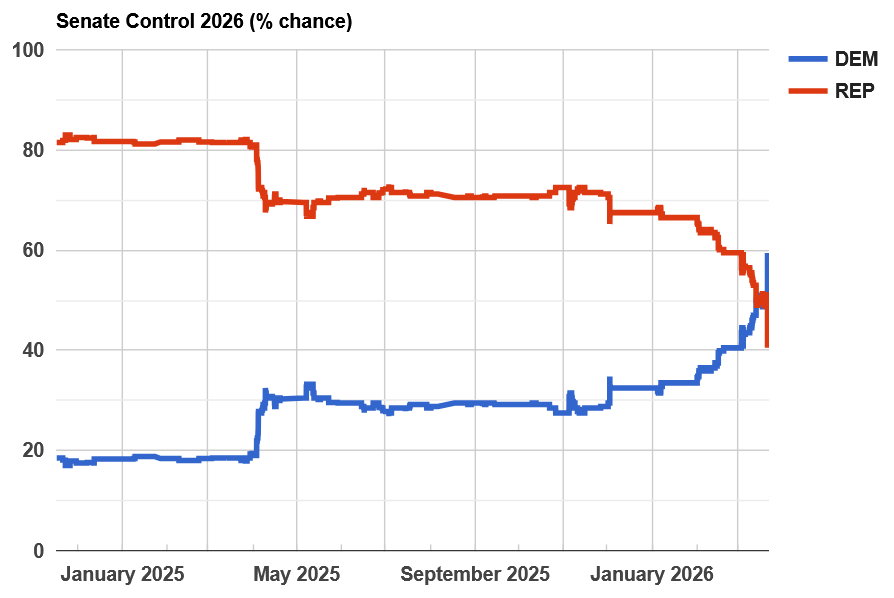
That's the 'Trump put' in a single chart: a US President watching his Senate majority evaporate in real-time doesn't let US$5 a gallon petrol persist for long, so it probably won't.
The biggest risk for Australia isn't the oil shock itself but that the urge to "do something" worsens the situation before the crisis is resolved. Let's hope cooler heads prevail.


