
Paul O'Malley's misunderstandings about AI and trade
The risk to Australia isn't using AI built elsewhere but letting domestic incumbents like CBA use 'sovereignty' as a shield for protectionism.


Paul O'Malley, chairman of the Commonwealth Bank of Australia (CBA), used his speech at the annual Australian Governance Summit this week to warn that artificial intelligence (AI) could "shift economics offshore, concentrate risk, and weaken the domestic institutions Australia relies on".
The risk, he said, is not adopting AI too slowly but "becoming a passive consumer of value created elsewhere". His solution is for Australia to "owns the tools" of AI and "participate in every element of the AI stack".
According to O'Malley, Australia needs to be a major player on the supply side of AI or "economic rents" will be "extracted out of Australia", diminishing the tax pool and our ability to fund "everything that is essential and unique about Australia's great quality of life".
O'Malley is essentially making a mercantilist argument that could be – and often is – applied to everything from chips to wheat. What it ignores is trade. Australia doesn't build its own commercial aircraft, design its own semiconductors, or develop its own cloud infrastructure. Nobody wrings their hands about how Boeing "extracts" rents out of Qantas because the consumer surplus Australians capture from using world-class products built overseas is the gain.
The same logic applies to AI. If US firms supply AI tools to Australian businesses and households, those transactions only happen because Australians value the service more than the price. The rents are being split, yet in O'Malley's framing the Australian consumer's share is invisible.
We've heard this argument before. For decades, Australian car manufacturers and their allies made essentially the same case: that Australia needed to 'own' its automotive capability or risk becoming a 'passive consumer' of value created in Japan and Korea. Thankfully politicians eventually stopped listening, the industry died, and car prices fell for two decades straight while Australians got access to better cars than the domestic industry ever produced.
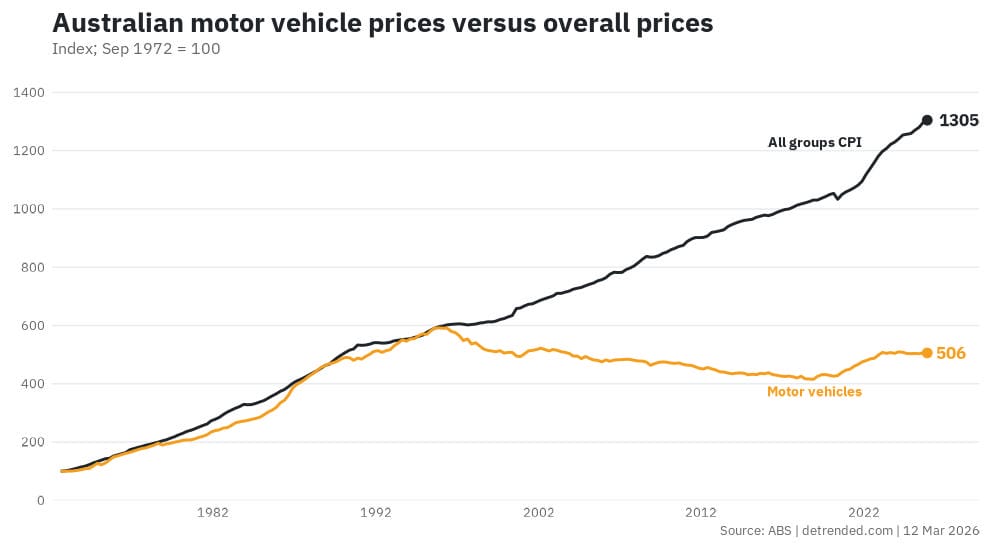
Where O'Malley does have a point is on tax, which has been an ongoing issue with big tech companies such as Google using so-called 'transfer pricing' to minimise taxable income where the revenue is actually generated. But that's a tax design question, not an AI strategy question. Conflating the two leads to exactly the kind of protectionist policy response — in O'Malley's words, "settings that encourage domestic capability" — that makes everyone worse off, other than a small group of domestic AI industry insiders.
O'Malley said the debate is "too often framed as large business versus small business, as if one has to lose for the other to win". He's right, but the relevant framing isn't large versus small; it's producers versus consumers, the latter of which will benefit from cheaper, better AI tools regardless of where they're built.
So, why did O'Malley make such brazenly misleading statements? The charitable view is that he's simply relating AI to financial services, a sector where he actually has domain expertise and where the regulatory architecture genuinely matters. If your mental model of "technology adoption" is shaped by decades in banking, it's natural to assume AI will work the same way: that you need domestic institutional scaffolding to capture the gains.
He might also just not know any better. He's not an economist, and the mercantilist intuition that imports represent value leakage is one of the most persistent and seductive errors in economic reasoning.
The less charitable view is that it's because industrial policy is in-vogue again, with the Albanese government going all-in on a "Future Made in Australia". CBA is Australia's largest bank, enormously profitable, and sheltered by an oligopolistic market structure that the four pillars policy effectively guarantees. When O'Malley says "we need settings that encourage domestic capability rather than unintentionally hollowing them out", he may as well be saying 'please regulate AI in ways that favour large incumbents with large compliance budgets over disruptive foreign entrants'.
O'Malley might frame it as "geo-economic risk", but with an ocean of open source models out there and cut-throat competition between closed source leaders like Google, Microsoft, OpenAI, and Anthropic, it's not clear there's any risk at all to not owning the models.
The historical track record of countries trying to build domestic champions in industries where they lack comparative advantage is, to put it mildly, not encouraging. Australia's comparative advantage isn't in competing with Microsoft's AI capex budget. The productivity dividend from AI will come from using it well and ensuring it's diffused through Australian firms, not from building it locally.
The risk to Australia isn't from becoming a passive consumer of value created elsewhere. It's listening to large incumbents like CBA who want to make sure the AI regulatory architecture is built around their business by talking their way into a seat at the AI regulation table.


