
The economics of a Liberal bloodbath
When your political strategy relies on a version of the economy that hasn't existed since 1960, a historic bloodbath is the only logical outcome.


I don't particularly like wading into the cesspit known as politics, but sometimes it has to be done. And the recent South Australian election, which was a bloodbath for the Liberal Party, is one of those moments.
Labor won at least 33 of the 47 lower house seats, the Liberals were reduced to just four, and One Nation (22.1%) out-polled the Liberals (19.1%) on primary votes for the first time in state history.
You might be tempted to conclude that One Nation's dominance means the Liberals should move further to the right. But don't confuse One Nation's vote share with a governing mandate: YouGov polling found that just 10% of One Nation voters actually backed the party's policies, with the majority simply feeling unrepresented by both major parties.
In other words, it was a protest vote, and boy did the Liberals make it easy for dissatisfied voters. Browse any discussion of the result and you'll find the same refrain: no one knows what the Liberal Party stands for any more. Just as Peter Dutton had no plan at the last federal election, neither did the South Australian Liberal Party in 2026. Lots of promises, sure, but very few well-considered, detailed, and fully costed policies. It was so bad that Labor's treasurer gleefully published a 57-page document showing billions in Liberal spending pledges with no credible funding sources.
It's clear that the Liberal Party is lost. Katherine Deves, who was a Liberal candidate at the 2022 federal election, posted a reel on Instagram dripping with 1950s-era nostalgia, boasting about the "standard of living and quality of life" back in the good ol' days (and how white it was, but I won't get into that). It's the kind of content that performs well in an online echo chamber but poorly with median voters around the centre.
Probably because it also happens to be wrong.
Just look at what Australians actually spend their money on. In 1960, food took up 32% of household expenditure; today it has halved to 16%. Clothing collapsed from 17% to just 3.5%. What grew? Recreation and culture, health, education, and housing. We went from spending half our income on food and clothes alone to spending it on holidays, healthcare, and bigger homes, all of which are much better quality than they were back then.
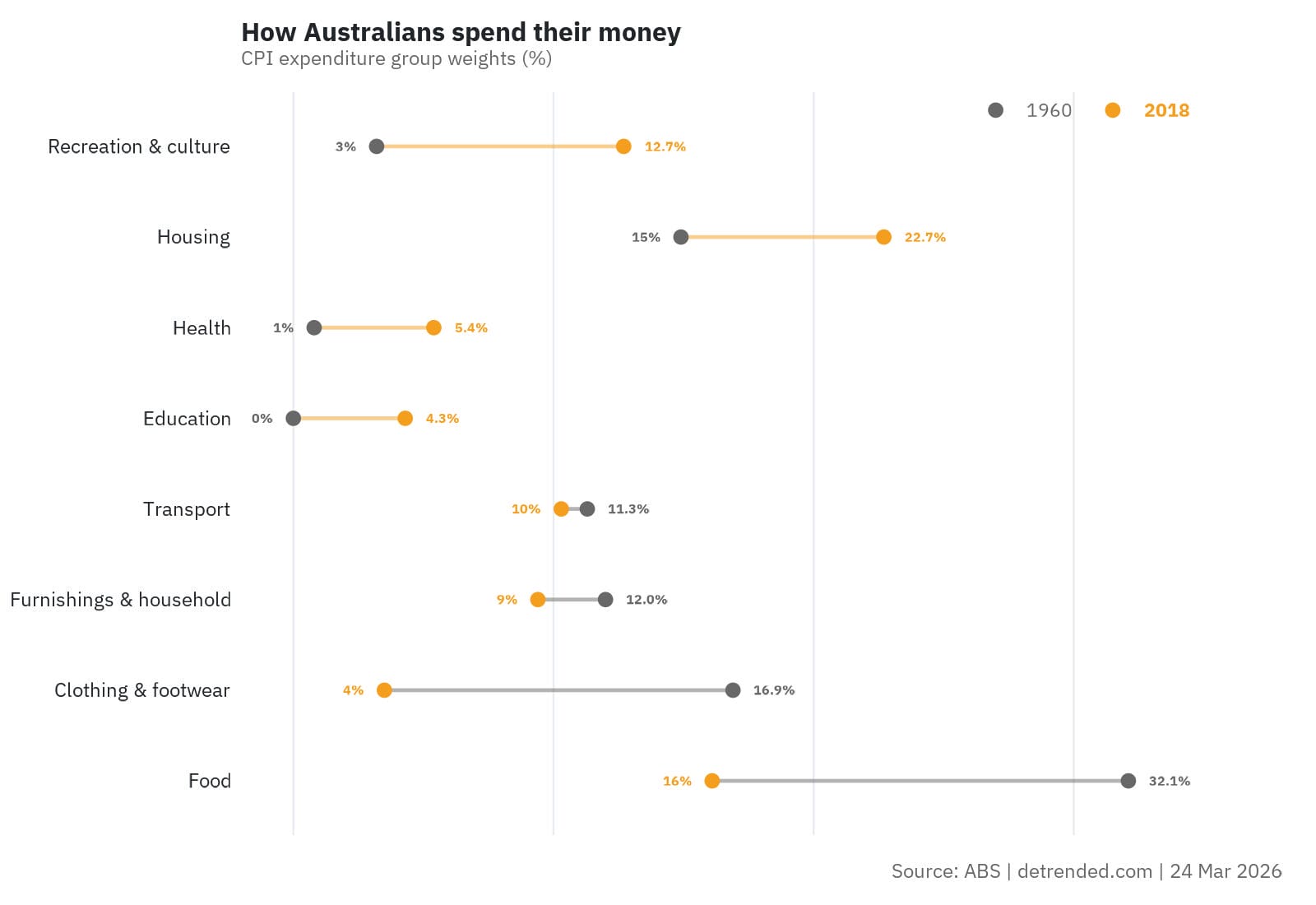
The one genuine exception is housing. It's absolutely true that Australian real house prices roughly doubled between the early 1980s and 2022. But once you account for quality changes (bigger, better quality, more comfortable), the increase halves, and real rents rose just 20% over the entire period from 1980 to 2022. So while housing is genuinely less affordable than it was, the gap is far smaller than the raw numbers suggest. And the solution is supply-side zoning reform, not winding the cultural and economic clock back to 1957.
The Liberals face an impossible squeeze. Politicians such as Deves and Andrew Hastie want to adopt the equivalent of One Nation's policies to win back regional seats, while Liberal Party moderates argue it needs to move to the left ('Labor-lite') to win back the cities.
Neither is a good strategy. In Australia's preferential voting system, you win elections from the centre. One Nation got 21% of the primary vote but will end up with perhaps two lower house seats because they're too extreme for median voters to preference. If the Liberals move out there, they'll suffer the same fate. As former Coalition pollster Mike Turner put it: "You vote One Nation, you get Labor."
But they'll encounter a similar problem if they try to mirror Labor or the Teals. Voters who want Labor-lite policies will just vote for the real thing. The Liberal Party needs to offer something distinctive from the centre: competent economic management, credible fiscal policy, and liberalising supply-side reforms on issues like housing and land-use planning. The things they used to stand for.
Chasing One Nation or Labor's flank just guarantees more Labor landslides. Posting Instagram reels about how much better things were when mum stayed home and houses cost five grand isn't an economic or political strategy. It's a fantasy, and if they keep it up, so is their hope of ever winning government again.


