
The economists who cried wolf
Argentina under Milei is a case study in how easily economists' politics can override the lessons of their own discipline.


As an economist, I'm a big believer in economics as an explanatory science. Once you learn and comprehend the fundamentals, you start to see the world through a completely different lens (it makes me a real hit at parties 😬).
But not every economist applies the lessons consistently; or at least, not enough to override their normative political beliefs.
Take the following case study. Ahead of Argentina's November 2023 national election, a group of 108 economists, including the influential Thomas Piketty, signed a letter warning that if voters elected libertarian economist Javier Milei as their President, it was "likely to cause more devastation in the real world in the short run, while severely reducing policy space in the long run".
According to the economists, that's because Milei's policy ideas were "fraught with risks that make them potentially very harmful for the Argentine economy and the Argentine people".
Two and a half years later, and the "real world" results of Milei's policies stand in stark contrast to the economists' warnings:
- Poverty down from 53% to 28%.
- Inflation down from 200% to 33%.
- Growth up to 4.5% in 2025.
- The first government surplus in 123 years.
It's not all sunshine and lollipops; the Argentine economy was in a bad way after several decades of Peronism, and it would be foolish to think anyone could right that ship after just two years.
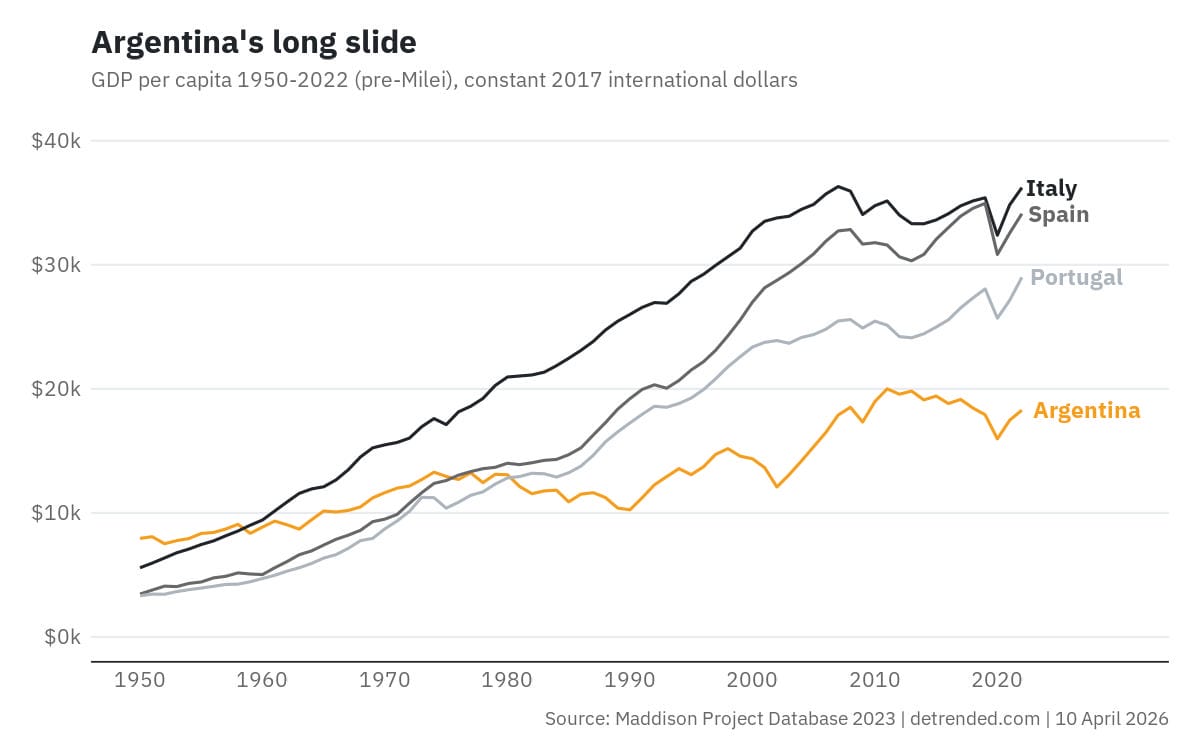
If I were to be critical of Milei, it would be that he has failed to achieve one of his key election promises of dollarising the economy. Another blight was the currency swap bailout from the US in 2025 , allowing Milei to maintain the peso peg at an unrealistically high level, preventing a renewed spike in inflation. The industrial sector also happens to be in the doldrums, although that's hardly unexpected given the sector was a key beneficiary of the Peronist import substitution protectionist racket.
But what hasn't happened is anything resembling the economic "devastation" forewarned by the group of economists that signed the doom and gloom letter ahead of the 2023 election. The IMF actually expects Argentina's economy to outpace global growth this year (4.0% against 3.1%), and every subsequent year out to 2030 when its projections end.
I'd like to think that such real-world evidence would lead certain economists, who so confidently predicted that Milei would destroy the Argentine economy, to update their priors. But I suspect that's highly unlikely; signatories like Piketty have built careers out of massaging the evidence to support their normative preferences, rather than evaluating policy based on the actual evidence. Just as leopards don't change their spots, politicised economists won't change their priors no matter how much evidence is stacked up in front of them.


