
The oil shock in context
Australia's current oil crisis is a race between a rapid global supply response and the domestic urge to 'do something' that inevitably makes the situation worse.


Petrol prices in parts of Australia have surged close to $2.50 a litre, the highest on record. Adjusted for inflation, today's prices are the second-highest on record after the 2008 peak (the current monthly average for March is $2.06).
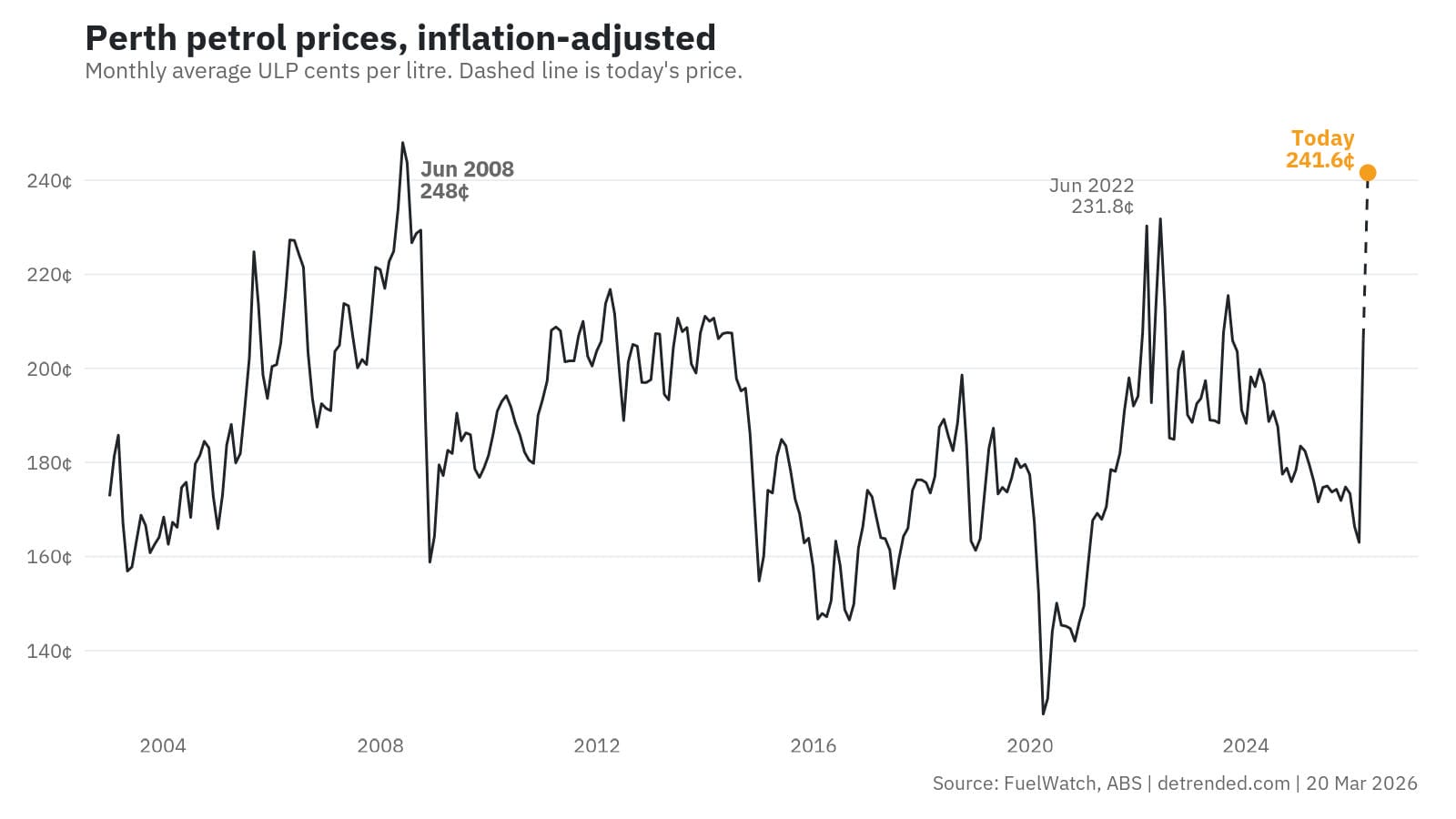
Make no mistake: that's going to hurt. It's not so much the price – the World got by just fine in 2022 and 2008 with prices at similar heights – but the pace of the change. Households will no doubt be feeling the pinch, but there will be businesses (e.g. airlines who didn't hedge) whose costs have doubled in a very short period of time.
The good news is today's shock is a pure supply disruption: the Strait of Hormuz closed, ~20 million barrels per day of oil transit got choked, prices spiked. Global demand hasn't surged; indeed, if anything the macro backdrop is soft with all the tariff uncertainty and a sluggish China keeping demand subdued.
That distinction matters because supply shocks tend to be more transitory than demand shocks, and the supply-side response has already been impressive. For example, Saudi Arabia has ramped up Yanbu loadings to over 2.2 million barrels a day via pipeline, more than double February's rate. The UAE is routing crude through its Abu Dhabi pipeline to Fujairah. The IEA has announced a 400-million-barrel emergency reserve release, the largest in its history. Marginal wells such as US shale oil producers will inevitably respond to triple-digit prices by cranking out every last drop.
The futures market agrees. While it'll still cost you $106 to secure a barrel in May, by the end of the year it's only $83. That's the market pricing in a front-loaded risk premium, not a structural repricing as you might expect from a demand-induced shock.
All of that means the best way to get through the crisis is to simply weather the storm. Australia is far less oil-intensive than it was during previous shocks, with services now dominating output in a way they didn't in the 1970s or even 2008, so a given oil price hits a smaller share of economic activity. And it's not all downside, given that Australia is a major LNG exporter and the recent damage to Qatar's Ras Laffan facility (which handles roughly a fifth of global LNG supply) will be a windfall for Australian producers (and the tax man).
Where Australia is genuinely exposed is supply. It imports roughly 90% of its refined fuel and holds just 37 days of petrol, 30 days of diesel, and 29 days of jet fuel. Under the International Energy Association (IEA) treaty to which Australia is a signatory, members must hold 90 days of net imports, yet Australia is the only member that doesn't comply (most members hold over 140 days' worth).
It's too late to do anything about that now. But it is possible to make the situation worse by talking about rationing supplies which will just scare people into loading up now, hastening the crisis, or threatening petrol stations with ACCC scrutiny for 'price gouging'. In reality, those high prices are the only thing keeping the tanks from running dry; they force consumers to prioritise, effectively doing the government's job of 'rationing' without the need for Soviet-style central planning.
I hope none of that eventuates, but it can't be ruled out when the Energy Minister and certain state Premiers seem to spend their days name-dropping the ACCC and talking about their emergency powers to ration petrol.
For now, the best case remains a quick resolution. The 'Trump put', TACO trade, still very much holds. Having already warned Israel off energy infrastructure after the Qatari incident, Trump knows that every week this crisis continues is a week closer to the US mid-terms. He simply can't afford $5 petrol (outside of California, of course), and that's the best bet we have that this storm will be a short one. Provided Australia's elected leaders don't screw the pooch in the meantime, that is.


