
A tax on capital is a tax on wages
Australia's capital per worker hasn't grown in a decade, yet Labor's response is to tax it harder.


In economics, it's relatively uncontroversial that taxes should be neutral, i.e. taxes should distort behaviour as little as possible. That's why economists are generally fans of broad-based consumption and unimproved land taxes: they apply to everything equally and are difficult to avoid.
In principle, changing Australia's 50% capital gains tax discount to inflation indexation moves it closer to that model. The problem has been in the execution; the Albanese government actually managed to make capital taxes more distortionary by:
- not indexing losses as well as gains;
- not averaging gains and losses over the years an asset is held; and
- imposing a 30% minimum tax rate.
Those three points alone will raise taxes on capital and make the tax regime less neutral, for three main reasons.
First, raising the capital gains tax rate increases the amount of double taxation. The government already taxes an asset's income, and the value of an asset fully reflects its expected future returns, all of which will eventually be taxed. If you also tax an asset when it's bought and sold, you're effectively taxing that income twice. Add in the fact that many people have already paid tax on the funds they use to invest instead of consume in the first place, and you get a whole lot of inefficient double dipping going on.
Second, not allowing losses to be fully deducted against gains introduces a distortion in the tax code against risk-taking. A higher capital gains tax raises the cost of capital, discouraging risk-taking. Less risk-taking means slower growth, lower wages, and fewer government tax receipts in the long-run (not that today's politicians care about that). The government might try to carve out exemptions for various sectors, such as tech, but that only makes the system more complex and more unfair—why is a plumbing business less important than a shopping app?
Third, Australia already has a progressive income tax regime. A 30% minimum rate on capital gains means the first dollar earned pays the same tax as the last dollar of wage income for anyone earning up to A$135,000 in a given year, and substantially more than their average tax rate. That will change behaviour in favour of earning low-risk wage income, low-growth dividend-heavy stocks, or just not selling assets at all. The fact any capital gain will be 'lumpy', and not averaged over the life of the asset, further adds to this new distortion.
All of that is a big reason why economists argue that a low rate of tax on capital gains is close to optimal (even zero under certain conditions). Ideally you want to tax people's ability to consume equally, yet going after capital gains taxes future consumption at a higher rate than today's consumption. In other words, it punishes patient people for doing socially-beneficial productive things.
So, assuming the Albanese government can get this legislation through the Greens in the next month (they don't work in July) and it 'sticks' through the 2028 election, what does it all mean for Australia?
It's well documented that Australia is in something of a productivity crisis. I was doing a bit of sleuthing through the aggregates and put together the following chart, which is now permanently available (and always up-to-date) on the members' charts page.
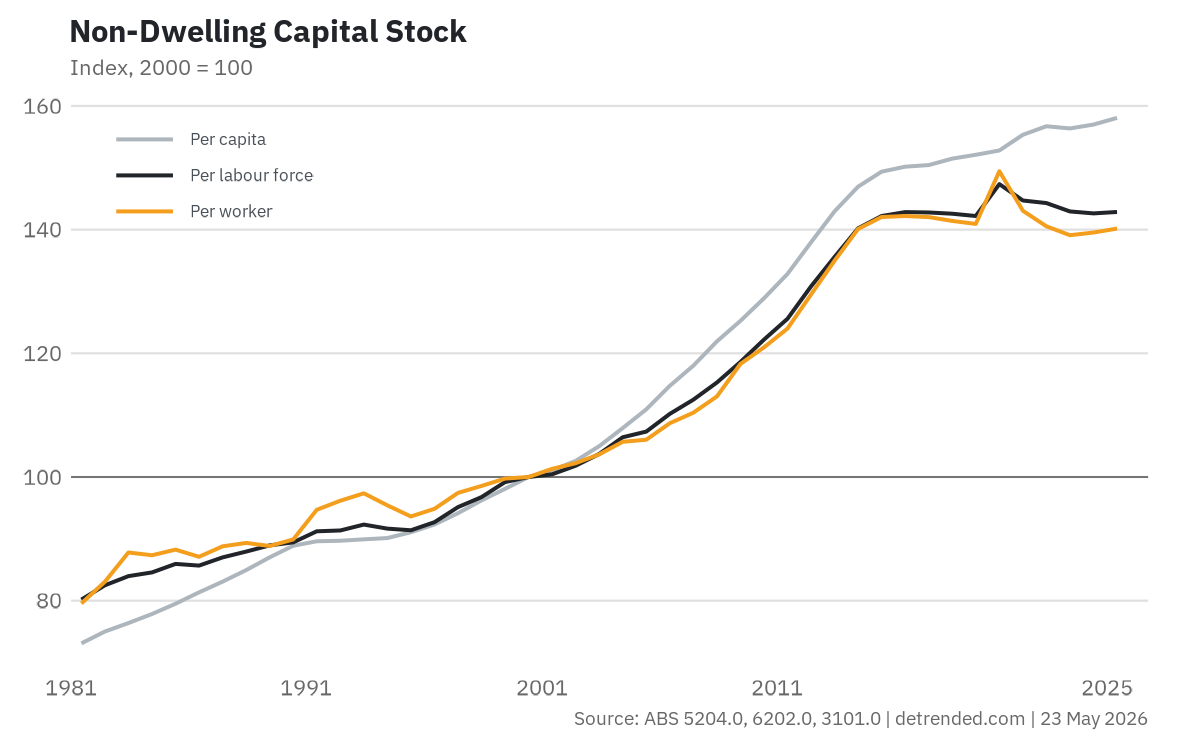
Something like half of economic growth can be directly attributed to the increase in capital formation, i.e. capital deepening. More capital per worker means their marginal product rises, their real wage rises, and we get more growth and higher living standards.
In Australia, the quantity of productive assets (e.g. machinery, equipment, infrastructure, and non-residential buildings) per worker is stuck where it was more than a decade ago. It's still increasing as a share of population (grey line), but that's only because so many more Australians have joined the workforce in labour-intensive non-market sectors like aged care and the NDIS, which require little capital. The all-important orange line is comatose.
Raising capital taxes in such an environment is a recipe for stagnation, not aspiration. Higher capital taxes means less investment, which means the capital stock grows more slowly. With less capital per worker, you get slower labour productivity growth, which ultimately means lower real wages. Essentially, a tax on capital is, eventually, a tax on wages that will harm the next generation much more than the current one.


