
Balancing the pain
Labor wants to meddle with interest rates, investing will have to change, and meeting the new Grok.


The Labor Party conference in Adelaide later this month is shaping up to be a real doozy. Not content with the plan to gum up the ability of AI to disrupt the status quo in Australia, its draft policy platform also includes a proposal to "reform" (there's that word again) the Reserve Bank of Australia. And not in a good way:
"Labor recognises that use of interest rate rises to curb inflation is a blunt instrument which hurts workers and vulnerable Australians first and hardest, rather than the asset class which plays a greater role in rising inflation.
Labor recognises that a balance must be struck between tackling inflation and ensuring that rising interest rates do not hit Australians who can afford them least."
History is chequered with examples of what happens when activist politicians try to strike a "balance" between using interest rates to curb inflation and "workers and vulnerable Australians": low growth and unanchored prices, i.e. stagflation, which ends up harming the very people they claim to protect more than anyone.
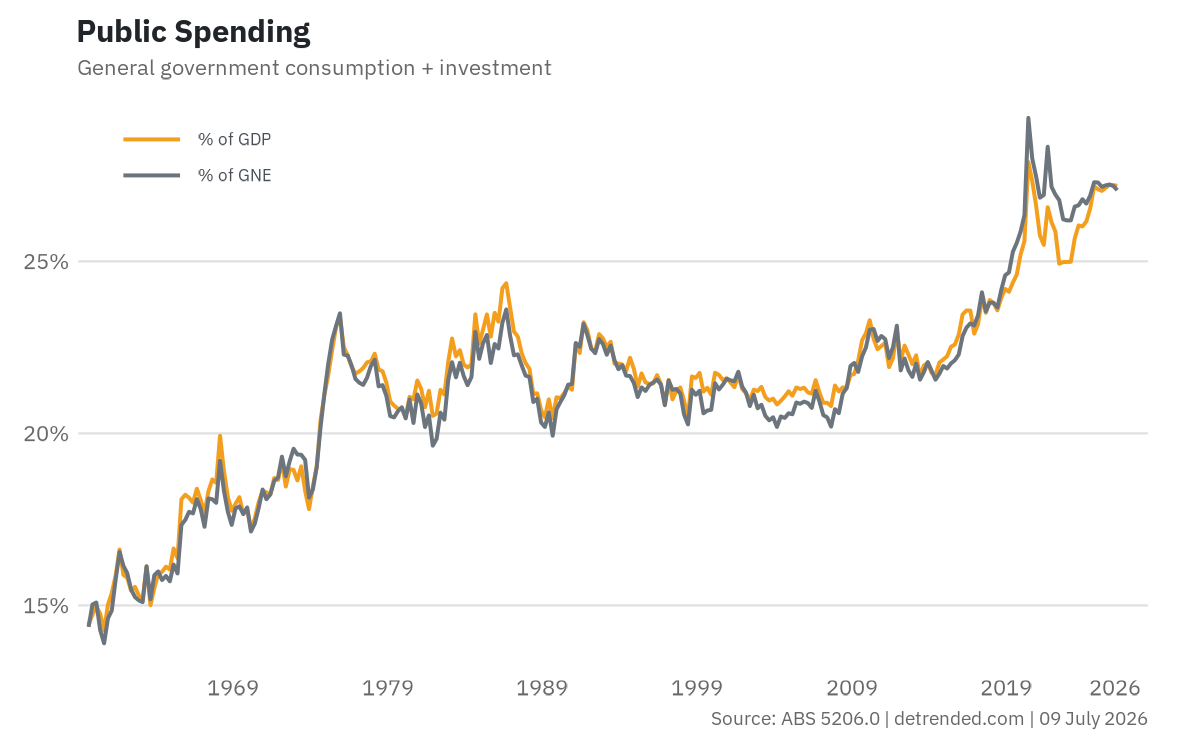
If Labor truly wants to protect Australians from higher interest rates, it should be publicly affirming the importance of maintaining price stability through predictable monetary policy. One of the best ways of doing that is through the path of expected future fiscal policy, which is fully in its control: provide a credible plan to close the structural deficit and repay the national, growth-sapping debt. That can be through higher taxes or spending cuts, but it's the latter that really cuts into expectations about debt sustainability and future inflation, as markets know tax hikes are often just to fund additional future spending. See this chart? Start working on getting it back towards where it was in 2017!
The unindexed trap
Labor's forthcoming tax hike on capital gains, which crucially does not index losses for inflation, will unfortunately mean marginal tax rates on investing in Australia could reach as high as 80% under certain conditions.
The key for investors will be avoiding those "certain conditions". Essentially, a diversified portfolio with lots of individual holdings weighted towards high-growth, risky assets will be the most exposed after 1 July 2027. You know, exactly the kind of portfolio that helps provide much-needed liquidity to start-ups and the like, which drives frontier innovation and productivity.
But it's not all bad; investors will inevitably pivot into low-fee index funds, which are the best way for the average Joe to get ahead in the long-run thanks to the beauty of compounding with minimal transactions. There are also so many index funds these days that an investor can still relatively easily target diversified growth or yields within a single fund, depending on what investment phase they happen to be in.
But index funds favour larger firms, meaning that smaller Australian companies will face an investment disadvantage going forward, making industry disruption all the more difficult. Perhaps that kind of de-risked economy is what Labor wants for Australia; one where everyone is a unionised wage slave, capital accumulation is actively discouraged, and the country simply meanders along like a mediocre low-growth European nation. That's all dandy, except without growth you can't pay for all the promised spending, which means some very difficult trade-offs might have to be made.
The infrastructure moat
I've been spending a lot of my time recently fooling around with AI tools. In the last week, I built an entire fantasy sumo draft platform from scratch (if you're a sport/fantasy nut like me, get some friends together and give it a try – the next tournament starts tomorrow!).
So, I'm always keen to investigate when a new model drops, and the newest, shiniest of the bunch is Grok 4.5. According to Elon Musk, the new Grok is "roughly comparable to Opus 4.7, but much faster" (for those out of the loop, Anthropic's Opus 4.7 was released back in April). It's also the first version of Grok that was trained on Cursor data, the coding platform SpaceX just acquired for a cool $60 billion.
Elon's tweet reveals something interesting about the ever-evolving AI landscape: the frontier is now owned by just two firms, OpenAI (GPT 5.6) and Anthropic (Fable 5), but it may not matter. There's a lot of room for models that are just below the bleeding edge but are extremely economical, and Grok 4.5 is just that—provided you keep your context window below ~200K, after which it doubles in price (in the AI world, the larger the context, the more stuff the model has to consider before generating the next token, which soaks up costly VRAM).
Perhaps that's how AI is going to start fragmenting. SpaceX's prospectus indicated that 93% of its projected market opportunities were AI-related, mostly in "enterprise applications". Maybe Elon sees a bunch of Grok agents running billions of relatively small tasks in the background for businesses, meaning there's no need for large context windows or frontier-level intelligence (incidentally, that's also the path Meta is following, with its new Muse Spark 1.1 model launching with "aggressive and attractive" pricing). The flip side is such models also face the most competition from China, but then again SpaceX and Meta might be quietly confident that Washington will regulate a metaphorical moat that Chinese AI won't be able to cross.
The trillion-dollar question is how the AI market will shake out. There's already a clear gap between how the average person uses AI (in-browser chatbots) and how coders are using it (agents with multi-step workflows). I find the latter extremely promising, but I'm also fully aware that working directly with agents is likely beyond the average punter. And if chatbot AI is all most people are going to use of their own accord, that's going to limit the ability for AI diffusion; at least until someone, perhaps Elon, finds a way to seamlessly integrate them into other, more consumer-friendly products.
Have a great rest of your weekend.


