
The latest AI scare campaign
The Hugging Face hack, how to value AI firms, the Australian media's shaky legs, and who is Andy Burnham?


Last week a frontier OpenAI model (GPT6?) hacked into Hugging Face, a platform for open AI models. It didn't cause any damage because it was "hyperfocused on finding a solution for ExploitGym", its training goal, and eventually a Chinese AI model (GLM-5.2) hosted internally at Hugging Face managed to trace it and patch up any holes, doing "in hours what would usually take days".
An AI did a bad thing. But it didn't become self-aware and go rogue; it was simply following instructions and, in its own weird hyper-optimised way, executed a very mild version of the paperclip maximiser problem.
But this is still a big deal. It turns out that today's frontier models are really good at hacking. Instead of doing the hard work of trying to solve ExploitGym, the model decided it would be easier to exploit the dodgy OpenAI code that was keeping it in a sandbox, obtain internet access via another computer, and try to steal the answer from Hugging Face.
There are clear implications for cybersecurity. It's now much easier for bad actors to find vulnerabilities in internet-exposed devices and exploit them. But this also isn't new; every upgrade in processing power over the past few decades has made hacking easier, at least until defensive solutions catch up. What's special about this is that the speed of the shift is unprecedented. Expect massive demand for defensive AI services!
As for what governments can do, there's not much beyond air-gapping their sensitive networks. Governments could try to build "guardrails" through regulation, but that's not going to stop a kid in China; it would just slow down the adoption of positive AI uses. And banning open models would leave us all even more vulnerable: it was a closed American model that did the hacking, and the top closed American models refused to even help HuggingFace because "requests were blocked by the providers' safety guardrails, which cannot distinguish an incident responder from an attacker".
Sometimes the best defence against a hacker is another hacker. In this case, that means other AI, probably a Chinese one with open weights hosted on your own infrastructure.
Square this circle
Moonshot AI, the creator of frontier AI Kimi K3 that's on-par with the leading US models (and will have its weights opened next week!), is apparently preparing for a final fundraising round in Hong Kong "in a bid to raise capital at a valuation of as much as $50 billion".
Moonshot's model is essentially identical to those of leading US AI companies Anthropic and OpenAI. The only major difference is the latter two run their own closed-weight models, while Moonshot provides open-weight models. Oh, and the latter two are each hoping for a $1 trillion valuation.
I just can't fathom how closed models that face intense competition can justify valuations 20x higher than a comparable Chinese competitor. Their revenue-generating businesses are the same: per-token API usage fees, user subscriptions, private cloud deployments and model fine-tuning, and integrations with third-party software and hardware products.
Are consumer lock-in and switching costs really that strong in America? Is guaranteed access to Nvidia's frontier chips worth such a premium? Are customers willing to pay significantly more for bleeding-edge frontier capabilities and the safety guardrails used by OpenAI and Anthropic? Or are the regulatory and compliance constraints so strong that US companies will be forced to use local models, regardless of their preferences? That the US might soon block foreign competition, as Axios reported, suggests it's probably the latter.
I just hope the Albanese government's new Office of AI doesn't follow Trump on this particular act of economic self-sabotage; if it does, it would be the AI equivalent of forcing Australians to buy over-priced yank tanks instead of cheaper, higher-quality Toyotas and BYDs.
The fourth estate's shaky legs
The Albanese government has apparently been paying off the Australian media. Not content with the $1 billion+ that goes to national broadcasters the ABC and SBS every year, it created a grants program called the "Journalism Assistance Fund", which in just 28 days funnelled $67.6 million directly to Nine, Seven, Crikey, The Conversation, The Saturday Paper, and even Mamamia (a "women's media group"). The program will run through to June 2028, conveniently just one month after the next federal election is due.
I'm generally against corporate welfare, regardless of the sector; there are very few exceptions. But this particular case sets an extremely dangerous precedent. A functioning democracy requires a free media, commonly referred to as its fourth estate because of the role it plays in keeping the government accountable to the people. When the government starts to pay "the wages for journalists producing core news", some of which is news about the government itself, that estate can quickly crumble.
I'm not saying that mainstream Australian media has been completely compromised. Just that at the margin, the Albanese government (and Morrison government prior) has shifted the incentives away from truth-seeking and towards the appeasement of the ruling party.
This may all be a nothingburger. But it's directionally problematic for those who value democracy, and is not a good look for a government elected on the premise of restoring "transparency" and "integrity" to public office.
Manchesterism meets the bond market
Andy Burnham is Britain's new Prime Minister. From what I can gather, his policy views are to the left of outgoing Labour PM Keir Starmer. Burnham "identifies as a socialist", and describes his political philosophy as "Manchesterism", implemented through interventions such as the nationalisation of major utilities, significant public housing, rent control, and a large role for trade unions. He promises "balancing growth with equity", but the economic realities of these tools mathematically point toward stagnation.
As for what he has done in his first few days as PM, there's not much other than some run-of-the-mill politics. For example, Burnham has already cut VAT (GST) on household electricity bills, and capped English bus fares at £2.
Neither of those is good economics. There's a time and a place for tax cuts, but the VAT is perhaps the most efficient tax available to the cash-strapped UK government, and electricity is expensive because it's relatively scarce due to the Iran and Ukraine wars and its own green transition policies. In such an environment, cutting the price dulls the scarcity signal, thereby limiting demand destruction and deterring investment in new supply. To the extent they're debt financed (of course they are), they risk raising inflation and then interest rates, quickly eroding any temporary "cost of living" gains people might enjoy.
As for the bus fare cap, people will still pay just as much for buses (probably more, because there's less incentive to think before using them), except it'll be through higher taxes rather than fares, with a deadweight loss tacked on for good measure. Should farmers and plumbers be subsidising city workers? Burnham thinks so.
Burnham also has some potentially good policy ideas, although I'm not sure he'll be able to execute them, or even announce them. One example is a land value tax, for which he has "long been persuaded". Such a tax would have to completely replace the highly distortionary stamp duty, a politically fraught task; people are quite averse to paying tax on something they already own, so any switch would inevitably be slow (opt-in) and lacking in economic impact for some time, or fast and politically painful.
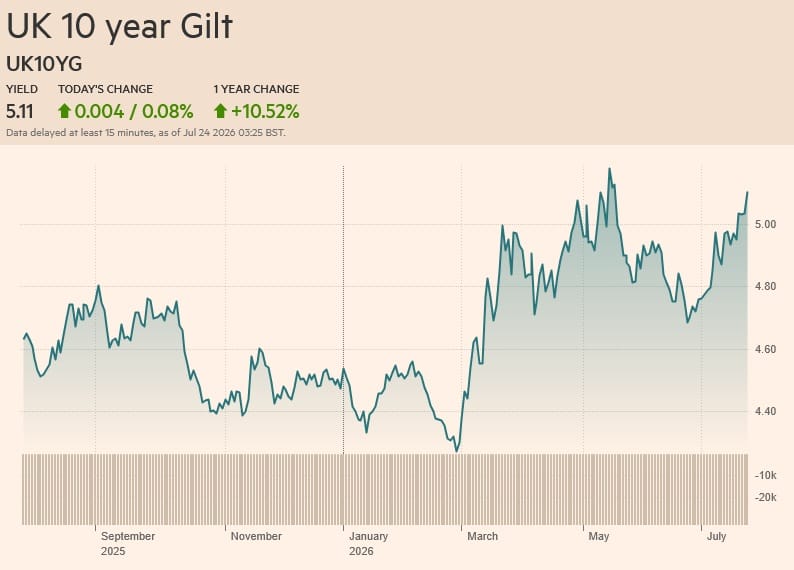
Burnham certainly has the slogans, but there's still no real economic agenda. He has promised to release a socialist-style 10-year plan for Britain later this year, but credibly paying for it will be a challenge. UK 10-year Gilts are already close to 20-year highs, and the quick fall of Liz Truss showed that bond vigilantes don't care much for empty promises of repayment.
Admittedly shallow Prediction markets give Burnham a ~60% chance of remaining in office by the end of 2027. To me, that says more about the state of UK politics than his governing competence.
Have a great rest of your weekend.


