
There is no moat
Chinese AI models are really good and the LLM space looks set to be commoditised, with consequences for the owners of the leading closed models.


By now you've probably heard of Kimi K3, the flagship model of Beijing-based Moonshot AI, one of the main Chinese players in the LLM space. It was released last week and quickly smashed various benchmarks; this leaderboard put it only a smidgen below Fable 5 and GPT 5.6 Sol, the two leading American AI models, while on a cost per task basis it's clearly right at the frontier of efficiency.
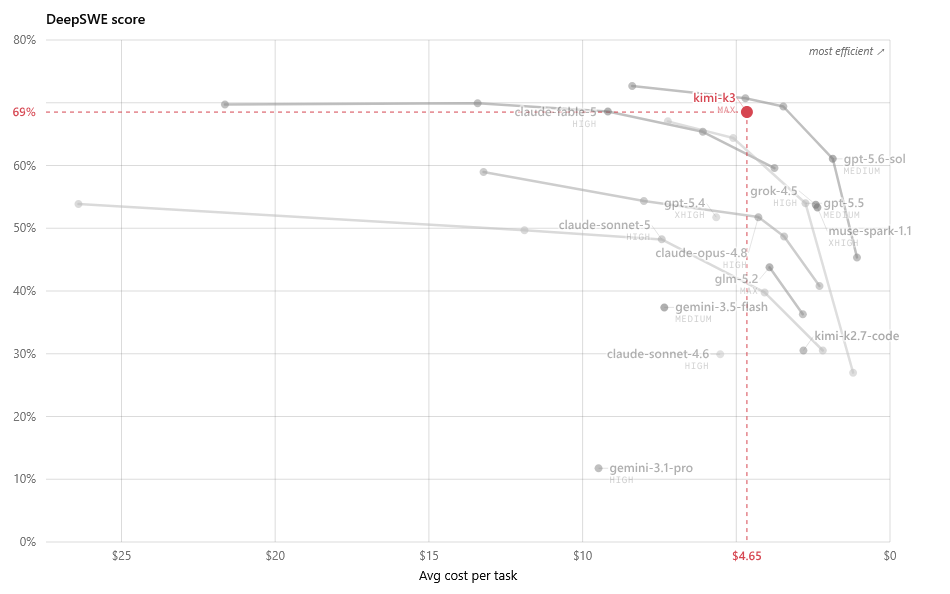
I've been testing it rather sparingly because of aggressive rate limits on the free tier (I don't have a Kimi subscription), but from the exchanges I've had it really is right up there with Claude Fable 5. I was already a fan of Kimi's K2.7 model for certain tasks, so I'm sure once K3's weights get open-sourced (27 July) I'll be using it for a lot more.
Now, the implications. The fact that a Chinese company was able to create a model that's close enough to the frontier that it is the frontier, despite all the trade restrictions on chips, is impressive. And I'm sure it'll soon be followed by other equally impressive Chinese models such as DeepSeek v4 (final), GLM 5.3, and the already-announced Qwen 3.8.
But what's most worrying for the likes of OpenAI and Anthropic is that it's very unlikely K3 was trained using what's known as a model distillation attack, which is basically the act of using an existing frontier model to help train your very own model (i.e. reverse engineering). Chinese AI companies definitely used that method extensively in the past (DeepSeek in particular), but K3 couldn't have used that method because of the timing: Fable 5 was only just released without strong usage restrictions – perhaps precisely because of K3's release, which meant Anthropic no longer needed to guard it against distillation – and GPT 5.6 Sol has only been public for less than two weeks.
That means Moonshot trained K3 almost entirely in-house, so the knowledge required to build a frontier model is no longer exclusive to Silicon Valley.
I've said it before and I'll say it again: there is no moat for these AI model companies. Once the algorithmic knowledge diffuses, as K3 proves it has, the model layer rapidly commoditises. Barring strong protectionist government regulation that would condemn US consumers to inferior, overpriced AI, Anthropic and OpenAI are going to need to hope their other products that utilise AI can differentiate themselves to justify their lofty valuations.
For OpenAI, that seems to be hardware: they acquired former Apple designer Jony Ive's company last year and might be about to release a screenless speaker. For Anthropic, I'm not entirely sure what the plan is; they've done well at the enterprise/API level, so perhaps the plan is to rely on ecosystem lock-in and high switching costs. If so, good luck to them once open-source equivalents catch up. Either way, we'll know a lot more when its prospectus is released later this year.
But more broadly, the arrival of K3 and promise to open source its weights within a week is unambiguously good for humanity. A world with only a few closed-off models extracting monopoly rents from us plebs goes against the ethos of the internet.
As for the motivation of the Chinese companies, they have clearly decided that the LLM is a commodity and they're going to have to compete on running those LLMs. By open-sourcing the model weights, they're pursuing a classic 'commoditise your complement' strategy: driving the profit margin of the model layer to zero to capture all the value in the inference compute and energy layer, where China holds the structural advantage. Many people tend to assume that, because China is ruled by a Communist Party (CCP) that tends to use the strong arm of the state to direct a significant amount of economic activity, China is uncompetitive. That couldn't be further from the truth; Chinese people are incredibly capitalist, competition is cut-throat when it's allowed to occur, and AI is a government-permitted space for experimentation. The fact there's a side-effect of watching the US squirm will no doubt please the CCP.
But whatever the motivations, China is ensuring that the AI landscape will remain competitive. In an open competition with almost no artificial barriers, good luck to anyone trying to beat them.


