
Why falling house prices aren't always a win
Whether a fall in house prices is 'good news' depends entirely on why they are falling.


Australian house prices are falling. While the speed of the decline varies across the country, in some areas it's a very steep fall indeed: accordingly to Cotality, in Canterbury-Bankstown (Sydney) prices fell 9.5% across the last three months alone.
Depending on your perspective, that might be considered good news. Australia has some of the most unaffordable housing in the world, and the median value has increased 20.9% over the past four years. As this chart shows, it's just a fact that real house prices have risen far more than inflation during this century.
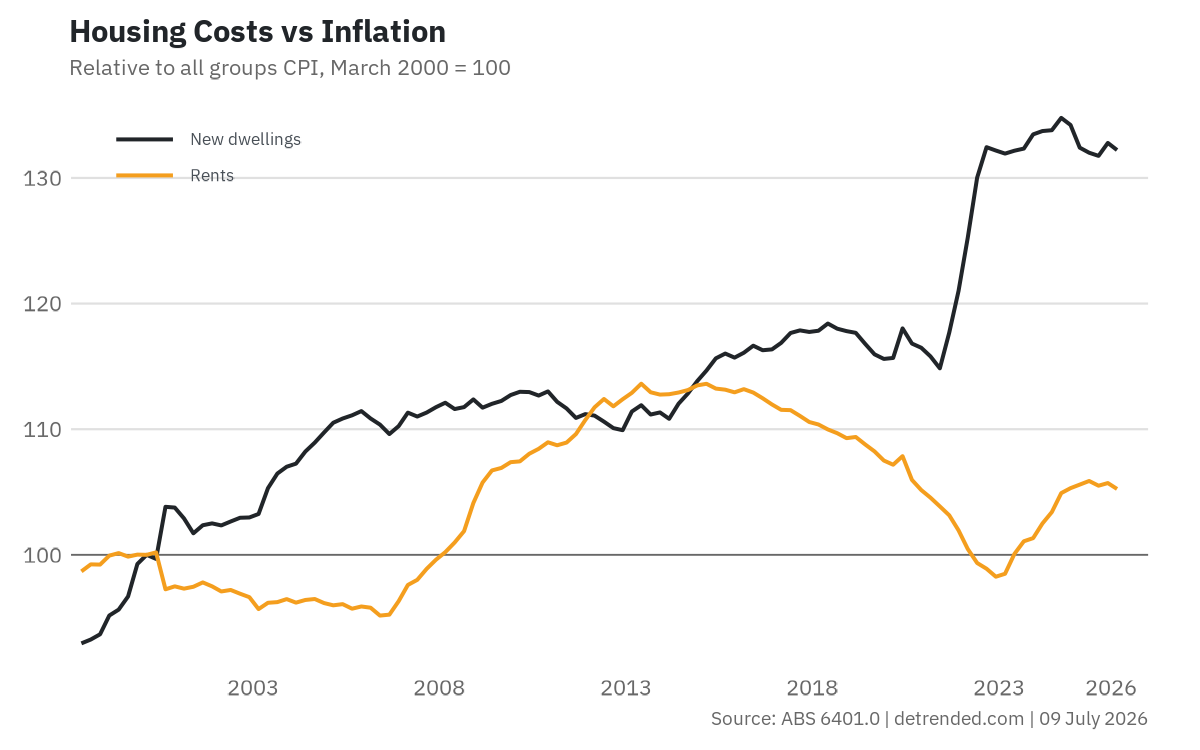
But when house prices fall, whether that's good or bad news depends on why prices fell. But you wouldn't know that from reading a recent op-ed from housing supply advocate Peter Tulip, who argued that:
"Whether the latest falls in house prices are attributed to interest rates (as the research says) or to tax changes (which research says is unlikely), we should be able to agree they are a good thing."
I fully agree with Tulip's policy preference for governments to loosen zoning restrictions to allow more building. That would create the kind of sustainable price falls in real house prices that actually lifts affordability and makes everyone better off.
But claiming that a price fall is unambiguously "a good thing" is reasoning from a price change, and it's a dangerous economic error. It matters an awful lot whether "interest rates" or "tax changes" are causing today's house price changes. If the leading cause of today's housing woes is indeed demand-side factors, then while they might lower prices in the short-term, they do not solve the underlying supply shortage. Worse, they may even reduce construction activity, making the long-term housing problem more severe. The "win" is ambiguous and potentially harmful for housing affordability, which is about mortgage payments relative to income, not just the sticker price.
Again, I'm supportive of Tulip's goal to improve Australian housing affordability. But by celebrating a price fall whose cause he does not establish, he weakens the case for his own solution. A price fall not caused by increased supply provides no evidence that supply reforms work or are needed.
Tulip's not alone in making this mistake. Prominent YIMBYs such as Jonathan O'Brien are known for tweeting things like "we should say house prices going down is the goal of good housing policy":
"When you sell your house, you buy another house. It's a consumption good, and if your house price falls, so have all the others. You will be fine."
Most houses are bought with mortgages, not cash. The 20-year-old who bought a house with the Labor government's 5% deposit scheme in Canterbury-Bankstown last year is most certainly not fine. They owe the bank considerably more than their house is currently worth, so they won't be able to sell and buy another because their equity has been wiped out (and some).
O'Brien is making a similar reasoning error that Tulip did: that because relative prices are unchanged, he claims no one is harmed from falling prices. But it matters why they're moving. If the price falls were due to supply increasing faster than demand (e.g., successful zoning reform), the harm would indeed be limited as society is genuinely wealthier because housing is cheaper to produce; there might be some losers (e.g. 5% deposit buyers or retirement downsizers) but the macro economy would be fine.
However, if prices are falling because of a demand shock – say, governments spending like drunken sailors, forcing the RBA to hike interest rates to combat inflation while also imposing a confidence-shattering budget tax shock on people – then people are likely facing job losses or significantly higher mortgage payments. House prices might fall, but many prospective buyers won't be able to get a loan to buy that cheaper house anyway, so affordability is at best unchanged, but could be significantly worse depending on the magnitude of the shock.
I sympathise with the YIMBY lot. But their economics is lacking, and it's only going to hurt their cause when they're out there in the media cheerleading for lower house prices regardless of the cause, telling people they "will be fine", even as one of the foundations of affordability is being ripped out from under them.


