
The one line that matters in Australia's Budget
If you want to know whether a government is leaving the next generation better off, watch what it spends, not what it taxes.


I'm going to be in Tokyo this weekend, so posting will be light until I return.
Australia's federal Budget, released moments ago, was sold as a generational reset. The capital gains tax was shifted from a 50% discount to inflation indexation. Negative gearing on existing homes was scrapped. Family trust distributions copped a minimum tax. The framing was that older Australians who built wealth through the old rules would pay more so younger Australians wouldn't have to.
It was also mostly theatre.
Start with the CGT change. Restoring indexation is defensible in principle; if you're going to tax capital (there are strong arguments against doing so), it aligns tax with real gains and can boost system efficiency. But the Budget dropped the discount without restoring averaging, meaning it now punishes so-called 'lumpy' gains at one of the highest rates in the world, which is deeply unprincipled. That's an especially punitive change for innovation and risk-taking; a founder who sells once after a decade, for example, will pay far more than someone realising the same total gain in annual slivers.
Capital is mobile and the talented people who generate it are more mobile still. There's a real risk of 'brain drain' if this survives the legislative process, with neighbours such as New Zealand, Singapore, Hong Kong, and even the UAE now offering zero capital gains taxes for risk-takers.
Then there's the removal of negative gearing on existing homes, which will lower house prices a touch and lift rents a touch. Or the minimum 30% tax on discretionary trusts, which closes a small avoidance channel. Cute, but not really "the hard road of reform" in the sense that matters: changing incentives and improving efficiency to raise productivity. If anything, the sum of the policy changes in the Budget will do the opposite by fining people for succeeding and discouraging investment.
Now to be fair to the Albanese government, not all of the Budget was theatre. The $1,000 standard deduction is a sensible piece of administrative simplification, as is the $20,000 small business instant asset write-off. The $2 billion for housing infrastructure (e.g. power, water) should help boost badly-needed supply. Cuts to the NDIS and ending wasteful, regressive subsidies such as the EV tax discount were necessary. But they're all tweaks, not structural reform. None of it changes the marginal incentive to work, save, or invest in a positive way, so the productivity needle won't budge.
But above and beyond everything else, there's one line in the Budget that can't be obfuscated by tax tweaks or Treasurer Chalmers' intergenerational rhetoric: spending. Today's spending is tomorrow's tax, and taxes create costly deadweight losses on society. If you actually want to know whether a government intends to leave the next generation better off, watch what it spends, not what it taxes. And on that front, the Albanese government is failing.
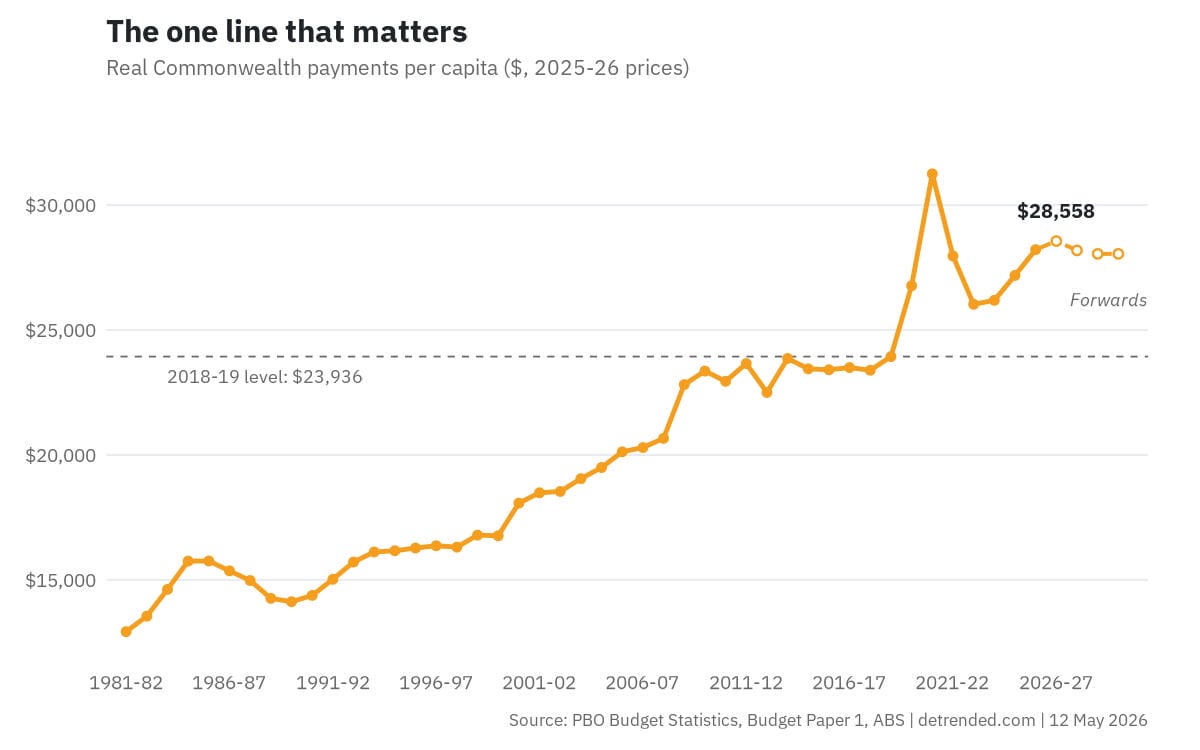
The picture is a staircase of fiscal indifference. Howard and Costello took the base from $16,000 to $20,000 in real per-person terms. Rudd used the GFC to lift it to $23,000, where it stayed until COVID. Morrison's pandemic response spiked it to $31,000, with the unwind settling well above the pre-crisis level. Then Albanese came along and, despite no emergency, will push it to $28,500 next year, with the forwards suggesting it's going to sit there until the next emergency inevitably sends it higher still.
Sensible fiscal policy should borrow for emergencies and pay the debt down in the good years. Australia does the first part well enough, but no leader this century has been capable of doing the second. And now the Albanese government has adopted a new model: ratchet up spending in the bad times and the good.
I suppose the biggest disappointment of this Budget is that Labor was given a strong majority at the last election as a sensible centre-left counter to the populist movement led by Trump in the US. And they've gone and screwed that up by blowing political capital on broken promises that leave the country worse off. No wonder the populist, anti-immigration One Nation party is performing so well; people are fed up with Australia's bipartisan mediocrity.


