
The intergenerational ruse
The coming budget isn't really about helping young Australians.


I've been waiting to write a post on the Albanese government's forthcoming budget (12 May) because there's still considerable uncertainty about what's actually going to be in it. Not a day goes by without a leak suggesting some new tax or handout, with the leading candidates being the replacement of the 50% capital gains tax discount with inflation indexation, along with a one-off $200-300 earned income offset cash splash to keep punters happy. Just what's needed with inflation well above target: more cash!
Before getting into any of that, I want to deal with the whole framing of the budget as all about "intergenerational" equity. Or is it equality? Depending on the minister, the two words are used almost interchangeably, even though they have drastically different meanings.
Equality means equal outcomes. Equity means treating people the same, given relevant differences. They are not synonyms, and in fiscal policy they pull in different directions. But conflating them is convenient if the goal is to raise revenue under the cover of 'fairness', because either word will do depending on who is listening.
Is that what the Albanese government is doing? Its actions to date suggest the answer is yes: spending by all levels of government is sitting near a non-pandemic high as a share of GDP, and is not budgeted to come down any time soon.
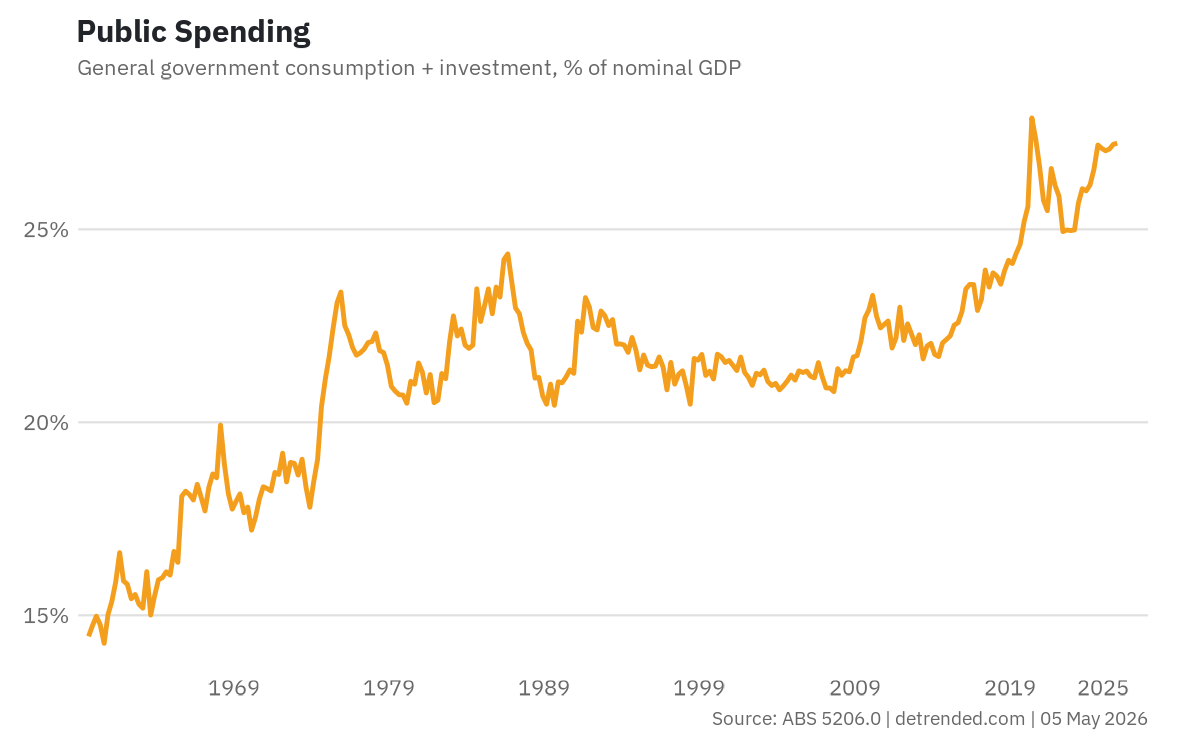
Deficit spending today equals higher taxes tomorrow, and the Albanese government's spending habits certainly don't look like it's worried about leaving the next generation with a less burdensome government.
The second move is on capital, and it's also being sold as intergenerational equity even though it works against it. Curtailing negative gearing, replacing the 50% CGT discount with indexation, and reportedly imposing a 30% minimum tax on trust disbursements all point the same way: higher taxes on saving and investment. There are good critiques of the 50% discount as an instrument — e61 has shown it's crude, under-taxes top earners, and encourages leverage — and as a stand-alone structural fix, indexation might be sensible ('might', because it's potentially a compliance headache for the ATO and taxpayers).
But the deeper problem is Treasurer Chalmers' framing. Wage income is taxed relatively heavily in Australia, so his logic seems to be that capital income must be taxed heavily too. This isn't new; remember his attempt to tax unrealised gains in superannuation? There's clearly a deep-seated belief that capital and labour are in conflict.
Rather than fix Australia's broken tax mix, he's just going to weigh down the other side. Personal income tax does too much work, bracket creep does more of it every year, and the right answer is a broader tax base — e.g. consumption, property — with lower marginal rates across the board for labour and capital, and indexation of income taxes (something Anthony Albanese dismissed last week).
Nations get richer when they accumulate more capital per worker, because that's what raises labour productivity and pushes wages up. Judd famously showed that capital taxes depress wages and that the optimal long-run capital tax converges to zero. The intuition is straightforward: capital is mobile while workers are not, so the burden (tax incidence) is ultimately shifted to the very people the tax is meant to benefit. And therein lies the heart of the Albanese government's intergenerational ruse: the young workers this government claims to be helping are the ones who will inherit a smaller capital stock and lower real wages because of these decisions.
Intergenerational equity/equality, in this budget, looks to be nothing more than a slogan attached to a tax grab on capital. Australia's youth would do better with a smaller government, an indexed tax system, and a lighter touch on saving and investment than with whatever the Treasurer announces on Tuesday.


