
Is there a crisis facing men?
The data on young men is genuinely mixed. You wouldn't know it from the commentary.


For a couple of years now demographer Simon Kuestenmacher has been pushing the idea that men, especially young men, are becoming "completely disengaged", and that this is "an issue of the highest urgency".
He has tried to make the case for both the US and Australia, with evidence for the latter resting on one chart in particular: the number of young people, by sex, neither in full-time education nor in the labour force—so called "NEETs". Essentially, the number of male NEETs aged 15-24 has increased as the number of female NEETs has fallen, to the point that they've now converged.
Kuestenmacher notes that young women were disengaged in large numbers in the 1980s because they left education early to raise children, and that the female figure fell for four decades as childbearing was delayed and university entry and participation rose. No problems there. But he then makes three big claims to explain the rise in male NEETs, all of which appear to be flat out wrong or oversold.
The first is schooling. He's right that "school is working better on average for girls than for boys". But school has always worked better for girls than boys, on average. So what changed, when, and by how much? Scholars such as Richard Reeves have argued that the economy's shift away from traditionally male jobs has made the school divide more obvious, but Kuestenmacher doesn't explain how it affects male NEET numbers.
Second is the apprenticeship model. Kuestenmacher argues that:
"Today, Australia counts 80,000 male apprentices while in 2011 this number was almost twice as high. This dramatic decline in the number of apprenticeships available leaves young men with limited options."
That's a real figure, but it's also highly misleading. The 2011 number Kuestenmacher uses as an anchor isn't a stable baseline; it's the last reading before a deliberate, multi-year wind-back of the employer incentives that had boosted apprenticeship numbers for over a decade. On NCVER's own timeline, various commencement and completion incentives were removed in 2011; commencements peaked in 2012 as further incentives went; completions peaked in 2013, ending twelve straight years of increases, with more incentive payments removed; and a range of other programmes ended in 2014.
The headline total also lumps trade apprenticeships together with non-trade traineeships, and it was the latter component that dominated the number in 2011 before falling away. On top of that, 2011 sat near the top of side-by-side resources and housing booms that drove unusually strong demand for trades.
Strip out those effects and the "dramatic decline" disappears. Over the long run, male trade apprenticeship commencements swing heavily with the economy and government policy, most recently surging under the Morrison government's Boosting Apprenticeship Commencements scheme that increased apprentice starts by 60% between 2019 and 2022.
Third, Kuestenmacher blames technology, arguing that getting young men "away from screens and back into the real world is a crucial challenge in minimising the NEET cohort since the negative consequences extend into the worlds of dating and politics".
There might be some truth to that claim, but it's highly contested. The first iPhone was released in Australia in 2008, and the employment to population ratio for males aged 15-24 not in education fell significantly in that year. But that also happened to be the peak of the global financial crisis, and the ratio for women also collapsed. In the years that followed the ratio drifted down a couple of percentage points before the pandemic came along, and now it's back up above where it was in... 1986.
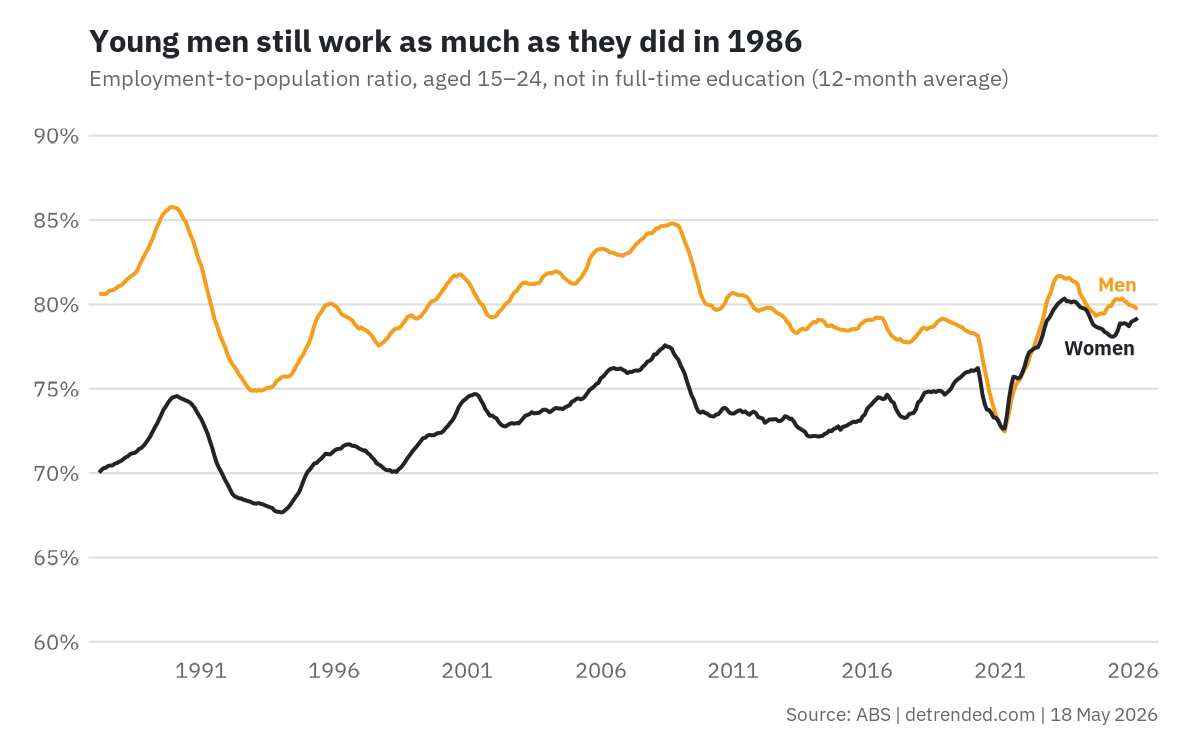
So is there a crisis facing men? The honest answer is that it's complicated. US prime-age male participation has genuinely drifted down over the decades, although it's currently above where it was more than a decade ago. Its causes are debated and far from settled, but the usual suspects such as the decline of manufacturing, an ageing population, and a more-educated workforce also happened in Australia... and yet there's no such secular decline Down Under.
The share of boys and men in the workforce in Australia has moved pretty much in line with the business cycle, and today sits within a percentage point or two of its late-1970s level, even as the female rate climbed roughly thirty percentage points to meet it. If the same structural shifts produced a male decline in one country and not the other, those structural shifts can't be the whole story.
This topic deserves serious attention, but Kuestenmacher's narrative is not serious analysis. Any policy recommendations that flow from such a dubious use of data should be treated with an equal amount of scepticism.


