
Chiefs of the salary cap
How Australian taxpayers are buying PNG an NRL premiership.

I know it's only Saturday, but I'm back from my whirlwind weekend in Tokyo so figured I'd fire off a post. I say whirlwind because I didn't actually get any further than Perth airport; a few hours after the scheduled departure the flight got cancelled for "mechanical issues". As the airline only flies to Perth three times a week, if I had accepted the replacement flight I would have basically had to land and turn right back around.
Tokyo will have to wait!
Anyway, the topic today is again the Australian federal budget. But I promise it's going to be much lighter than the past few and will hopefully resonate with sporting fans (I was supposed to be at live sumo and baseball this weekend!). As you might have gathered from the title, it's all about the NRL's PNG Chiefs.
Buried on page 91 of budget paper 2 was a single line:
"The Government will amend the tax law to ensure that income tax exemptions provided by Papua New Guinea for players and staff of the PNG Chiefs National Rugby League team operate as intended. This will decrease receipts by $5.4 million over four years from 2026–27."
It's no secret that the Australian government, i.e. taxpayers, will provide the PNG Chiefs' players and staff with a tax-free exemption. Without that concession, the new club would find it extremely difficult to attract players to move to what will essentially be a walled-off resort. Not exactly ideal for a 20-something athlete looking to socialise, find a partner, start a family and such.
What is peculiar is the estimated loss in revenue. Local media picked it up and reported it as the federal government revealing "how much the NRL's tax-free contracts will cost".
But the maths behind what the government reported reveals a sneaky truth that the media completely missed.
For a start, the $5.4 million is over four financial years from 2026-27. The Chiefs enter the competition in the 2028 season, which starts around March 2028, i.e. the back-end of 2027-28. So the window contains one year of nothing, a few months of season one, and then two full seasons. Call it two-and-a-bit seasons of foregone revenue.
This is where it gets peculiar. The Chiefs will field a 30-man roster under an $11.25 million salary cap in today's dollars, with a minimum wage of $140,000. If the Chiefs filled their entire roster with minimum wage players, that would be around $33,000 per player in tax, or about a million dollars a season. Multiply that by the two-and-a-bit seasons in the budget papers, and that's about half of it.
But the Chiefs won't be using 30 minimum wage players; they'll have several marquee and veteran players whose taxable income runs deep into the 37 and 45 per cent brackets. Run a realistic player distribution and the foregone income tax revenue is well over $4 million per season on the $11.25 million cap alone. And that's before the coaching and high-performance staff the budget line supposedly covers.
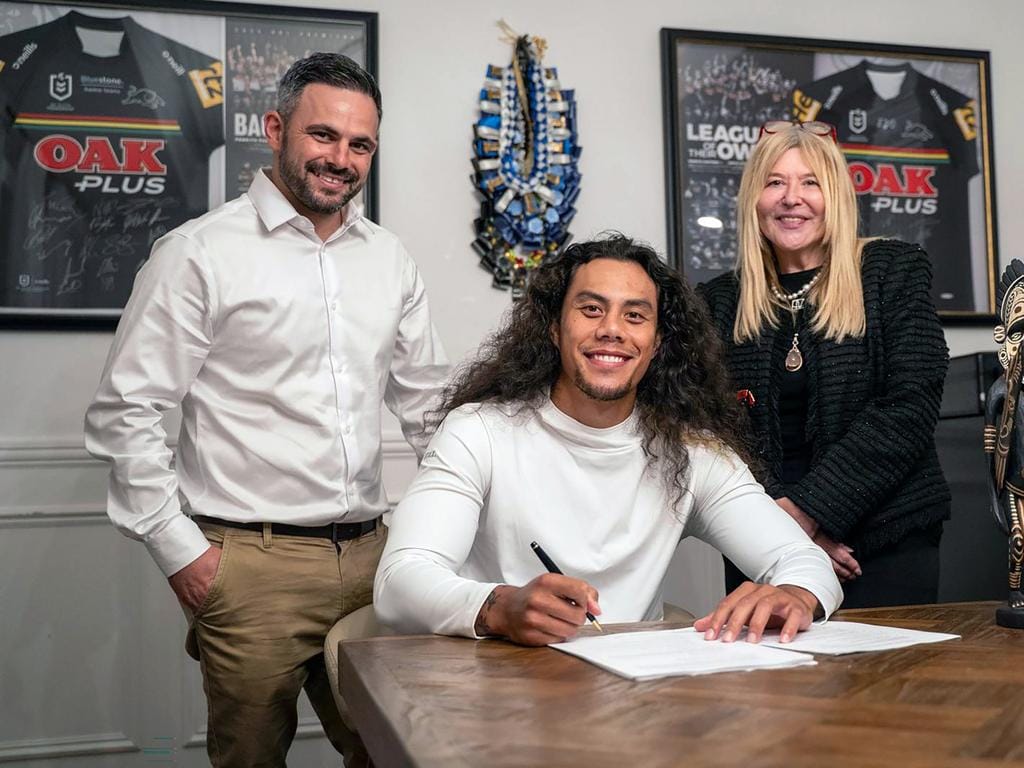
Let's use an example. One of the already-announced stars is Jarome Luai. He earns $1.2 million a season at the Tigers, around $500,000 of which goes straight to the taxman. At the Chiefs he keeps all of it, and that $500k each season will form part of the budget papers' estimate.
Basically, $5.4 million doesn't come close to reconciling with the actual cost. Just look at the Tigers' current roster: their top 10 players with publicly available contracts sum to $5.8 million in 2026, with a combined tax bill of $2.3 million. That alone would come close to filling the entire budgeted amount after two-and-a-bit seasons, with 20 players and the entire staff still unaccounted for. Unless the Chiefs are devoid of high-earning Australian marquee talent or they're all PNG-locals, Kiwis, or other internationals, the figure just doesn't stack up.
But there's also a deeper issue beyond the fictional cost to taxpayers of this exemption: the legitimacy of the competition itself.
The NRL salary cap is denominated in pre-tax dollars and binds all clubs under one tax regime. Except the Chiefs, which will operate under another. Take Luai again: to match a Chiefs offer worth $1.2 million in the hand, a Sydney club must pay around $2.2 million gross. Same cap dollar, nearly double the real cost.
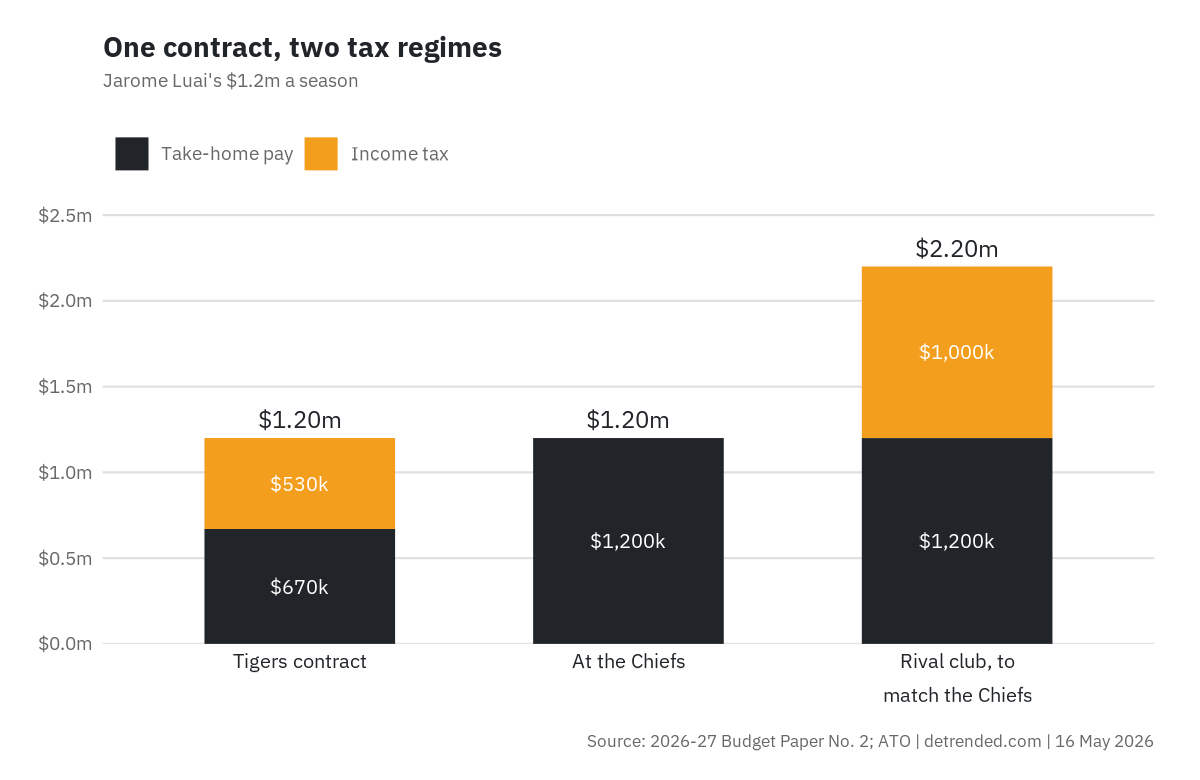
The Chiefs carry roughly a 45 per cent real cap advantage on marquee players before whatever other allowances they're given stack on top. Remember that the Storm won three premierships during the cap breach years with a cap advantage of around 30 per cent. The PNG concession is bigger still and fully sanctioned by the NRL and Australian federal government.
A salary cap that ignores the league's tax regime is not a cap. Barring huge roster and coaching mismanagement, if it stays this way the PNG Chiefs will almost certainly win a premiership within five years, and Australian taxpayers will have paid for it.


