
There will be no AI jobpocalypse
The economy's built-in roadblocks are bad news for anyone expecting an AI productivity miracle or an employment bloodbath.


Last week Joe Hockey said he expects 15% unemployment in Australia by 2031. The former Treasurer reckons AI and robotics are coming fast and at scale, Western democracies are "sleepwalking" towards it, and that "the biggest losers will be young people".
Being a former Treasurer, of course he's already counting the cost. He warns the tax base will be hauled off of income and onto capital and the family home, with a universal basic income to compensate the un- and under-employed.
It's a serious warning from a serious man. But the premise is seriously wrong.
There are two forces that could lead to 15% unemployment. On the demand side, such a malaise would require a collapse in spending, which is a purely monetary shock, not technological. People lose work in a slump because nominal wages are sticky and won't fall fast enough to clear the market when spending drops, so the adjustment lands on jobs.
The solution is to keep total nominal spending growing on a steady path so that the trap never springs: incomes grow into the adjustment and employment settles back at its natural rate, whatever havoc AI happens to be wreaking. In that sense, demand-driven unemployment on Hockey's scale would be a policy choice, not a consequence of technological change.
On the supply side, it's certainly possible that a technological structural shock leads to a mismatch between the skills people have and the work that's available to humans. If AI displaces workers faster than they can adapt, the natural rate itself would climb, and no amount of monetary juice would bring it down. That's a scenario worth taking seriously, but Hockey is badly overestimating how fast such an AI-induced shock can actually spread through the economy.
The (un)fortunate fact is the same forces that have stifled productivity in Western democracies over the past decade will also slow AI diffusion, whether it's excessive regulation, professional registration, the huge and growing share of non-market jobs, liability, or plain old organisational inertia. That reality will equally disappoint anyone expecting a productivity miracle and anyone prophesying an employment bloodbath. Even if AI is transformative, the economy's built-in roadblocks will inevitably give the labour market time to reskill, reallocate, and grow the new kinds of work that no one forecast.
It also helps to remember that a job is made up of many different tasks, only some of which are substitutable by AI. In 2016, future Nobel prize-winning computer scientist Geoffrey Hinton, aka 'the godfather of AI', predicted that because of AI and machines, radiologists were finished. A decade later, there are more radiologists than ever and their pay is the second-highest of any medical speciality. That's because reading scans was only ever a third of the job, with the rest being things like managing patients, treatment plans, coordinating care, and importantly, being insurable at the individual patient level. AI has disrupted radiologists in the same way that a century of automating accounting produced more accountants, not fewer.
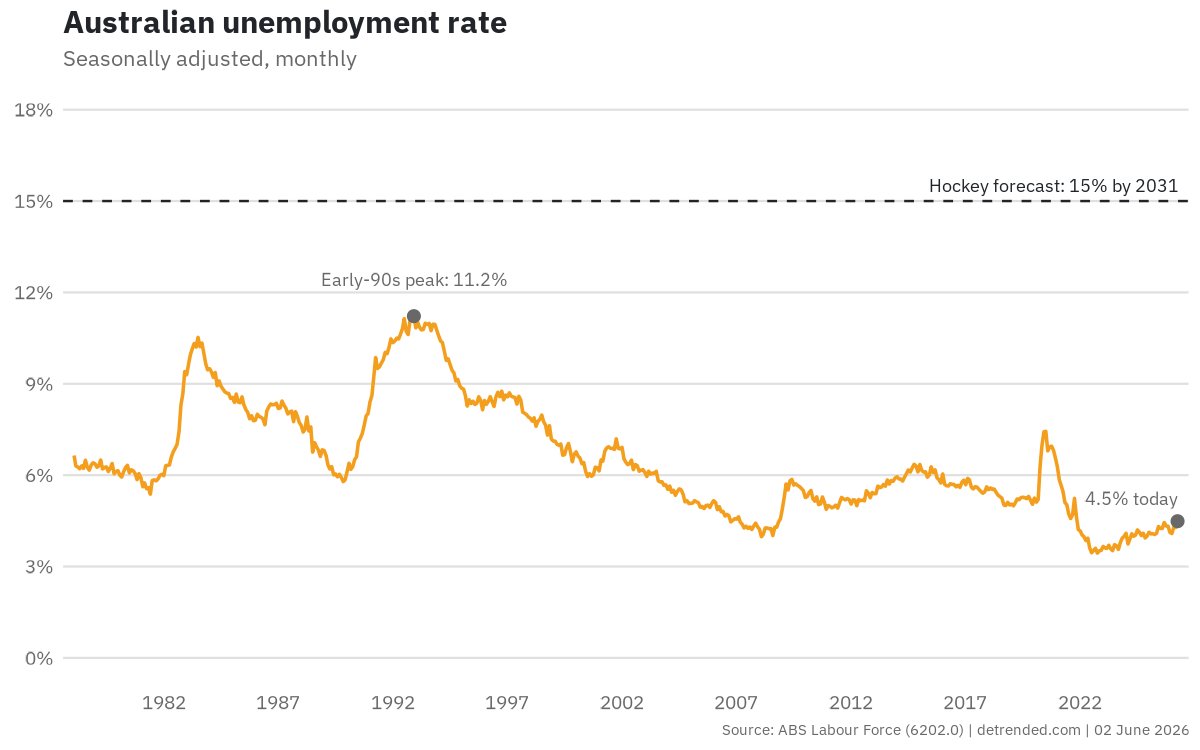
Hockey's forecast would see unemployment higher than at any point since the Great Depression. It's completely unrealistic, barring a serious monetary policy failure. While I share his worry that the push to tax capital, the family home, and the dead will only grow from here (just look at the latest Australian budget and comments from prominent Labor politicians), that push won't be because of a jobs apocalypse; it will be because of the inability of governments to stop spending so much, and an electorate unwilling to push back against it.


