
The PBO's bitter truth
Canberra's budgeting is industrial strength gaslighting, Westpac stands up for Superannuation, and Australia leads the world in occupational licensing, the productivity killer.


Australia's structural fiscal deficit isn't some mystery of arithmetic. It's the result of successive politicians making deliberate choices to extend and pretend, as the Parliamentary Budget Office (PBO) made clear in a rather scathing report this week. As an independent body, the PBO can't directly criticise the government, but with charts like this, it didn't need to:
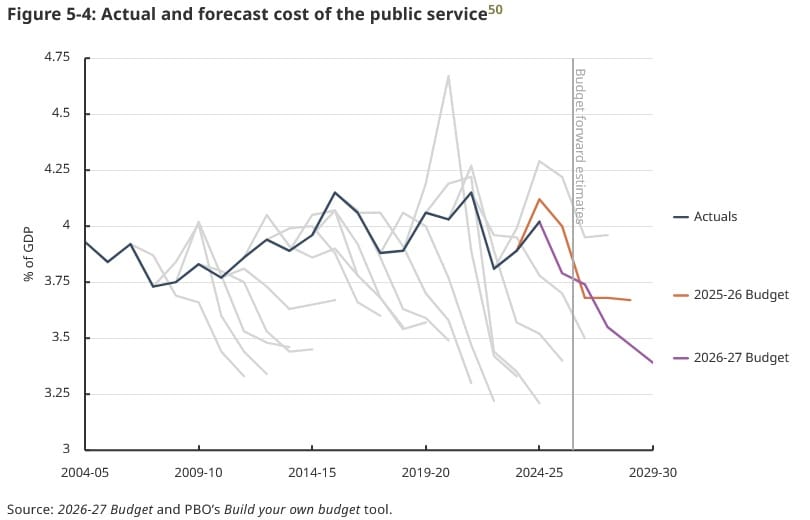
The Albanese government's budget rests on unrealistic assumptions, including that it will reduce the cost of the public service by more than half a percentage point of GDP (equivalent to tens of thousands of jobs). The assumed cuts to the NDIS are even more ambitious, and just as unlikely.
To be fair, this isn't just an Albanese government issue; every government over the past two decades has miraculously 'found' savings in places like the public service at budget time, only for the actual costs to continue creeping up to more than 4% of GDP. As Chris Richardson put it, "the ten-year figuring in any budget is industrial strength gaslighting", that allows the Treasurer of the day "to always claim that they're on a 'credible path back to surplus' when that's patently not the case".
If Australia is to regain fiscal discipline, the budgeting rules need to change so that the public is at least aware of what's actually going on.
Westpac draws a line
The government needs to keep its hands off superannuation. After PM Anthony Albanese signalled his desire for Australia's pool of superannuation to be treated as a "national asset" and used "for the nation", Westpac's CEO Anthony Miller pushed back in the strongest terms:
"Don't touch the super complex, don't direct it, don't tell it where to go."
Miller is spot on; Australia's superannuation is owned by individuals and should work for those individuals, not "the nation". The core purpose of the Super system is to fund the retirement of the individuals who earned the money, not to act as a fiscal piggy bank for politicians to play with. People like former Victorian Premier Daniel Andrews, who want the government to force Super to invest in "productivity challenges like housing, infrastructure, energy transition, water, or dare I say, pandemic preparedness", should be publicly condemned at the highest levels.
If the best place to earn risk-adjusted returns is through an investment in the government's Clean Energy Finance Corporation or pandemic preparedness, then so be it. But I sincerely doubt that's the case, because if it were, it would already be happening.
If it has a fiscal problem, the government should focus on removing deadweight losses in the tax system and spending less, rather than raiding people's retirement savings. Once politicians start treating Super as a fiscal tool, the contract that makes the system work will be broken and can never be put back together.
Licensing is a productivity killer
Occupational licensing is a productivity killer, and Australia is addicted to it. It's perhaps no coincidence that Australia ranks third globally for licensing restrictions – behind only economic juggernauts India and South Africa – while mired in a deep GDP per capita recession with zero net growth since the Albanese government was first elected. According to a recent Minneapolis Fed report, that comes at a cost:
"Licensing prevalence is negatively associated with GDP per capita and governance quality, and positively associated with informal employment, suggesting occupational licensing is intertwined with labour market efficiency, formalisation, and long-run economic development."
The authors make clear that the "relationships should be interpreted as descriptive rather than causal". But it's no secret that occupational licensing saps productivity in Australia by raising barriers to entry, reducing worker mobility, protecting incumbents from competition, and ultimately driving up prices for consumers.
Occupational licensing is less about quality assurance and more about rent-seeking. If the Albanese government is serious about boosting productivity, tearing down such artificial moats would be a decent place to start.


