
Killing with kindness
The minimum wage increases that are a boon for some may eventually lead to lost jobs for others.


After months of deliberation and lobbying by politicians, on Tuesday Australia's independent Fair Work Commission handed down its wage decision for the 2026-27 financial year: a 6% increase in the minimum wage, affecting roughly 100,000 workers, and a 4.75% pay rise for the nearly three million workers (around a fifth of the workforce) whose wage is linked directly to an award.
Both were above April's 4.2% headline inflation rate (distorted by volatile fuel and electricity – a better gauge, trimmed mean, was 3.4%), and the 6% increase matched the unions' ask exactly.
At first glance that might seem perfectly reasonable; given the recent inflation, why shouldn't workers get a large pay rise to keep their real wage growing? But it's not quite that simple.
A large increase in the minimum wage is trivial if a worker's output clears it comfortably. However, for workers sitting at the margin of what an employer will pay to keep them on, it could have serious consequences. That might be a shift not offered, a training role that quietly vanishes, or in cuts to the things wage data never sees, like flexibility, free food, parking, or other perks; anything to bring the total cost of employing them back in line with their marginal product.
The cleanest recent evidence is from Clemens and Strain, who found that large minimum wage increases in the US cut employment among low-skilled workers, while relatively small increases showed no clear effect. A single year's rise looks like the small kind, but Australia has now delivered increases of at least 3.5% for five consecutive years. The structure of the country's wage award system means those get pushed through much of the labour market, which risks compounding a series of hikes into the large-increase territory that can do real damage.
That's not a problem if labour productivity is also charging higher. But in Australia it has been pretty much flat for a decade, with output per hour worked at around 2019 levels. When labour gets dearer it tends to hit those with the least experience first, so it's probably no surprise that in Australia over the past year almost all of the rise in unemployment has hit in the 15-24 age cohort.
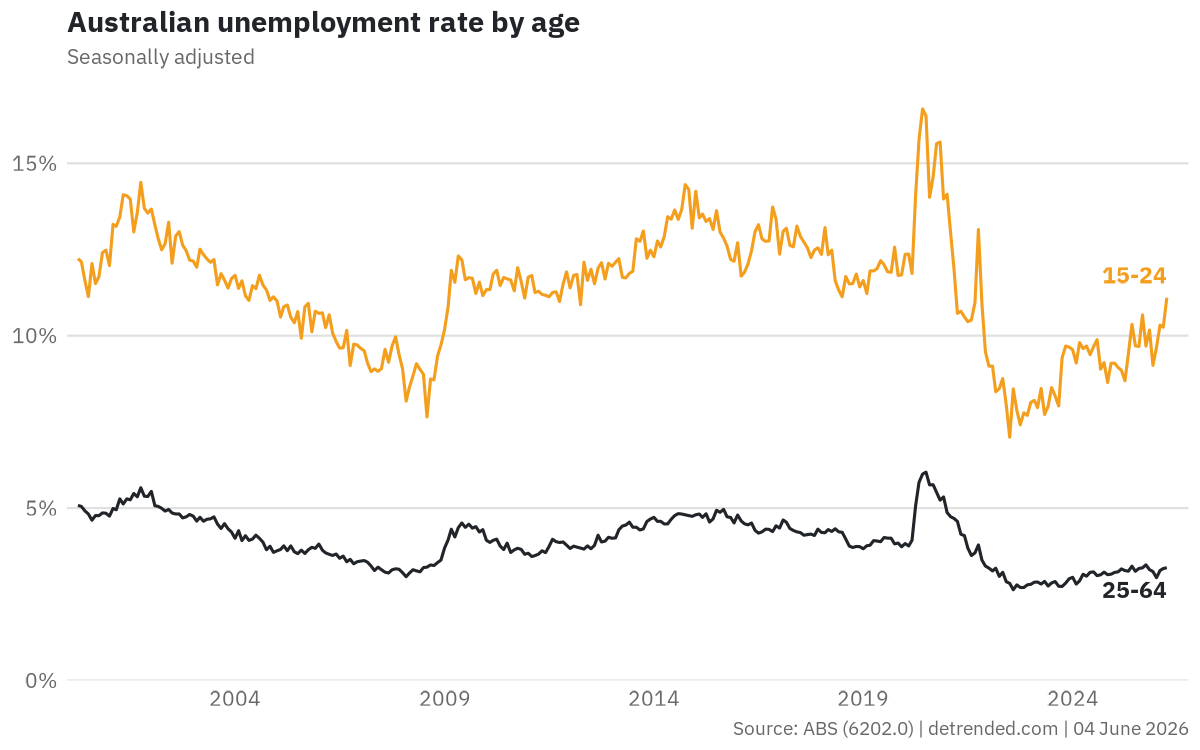
Real wages can only outrun productivity for so long. If the wage floor continues to rise against a flat productivity ceiling, the increases that are a boon for some will eventually lead to lost jobs and perks for others. That effect will mechanically raise overall productivity but only at the cost of higher disemployment, especially for the youth.
---
P.S. Regular readers will notice that I didn't mention inflation once in this post, even though this decision will no doubt be causing headaches at the RBA. That's because the catch-up politics, and wages rising ahead of productivity, are a symptom of inflation, not a cause of it. If the RBA is worried about the employment or inflationary consequences of the Fair Work Commission's decisions, it should credibly commit to restoring inflation to 2-3% as soon as possible.


