
When is a recession a recession?
Canada's technical recession, Australia's non-technical recession, and the worst public policy error in recent history.


Good morning and welcome to Detrended, where this week we're going to get a little technical.
Canada's technical recession
In the March quarter of this year Canada's economy got 0.03% smaller, which was enough to trigger what's known as a technical recession, or two consecutive quarters of contraction.
It's never good news when an economy contracts, but it's also not necessarily the start of "a major economic slowdown". In fact, I'm a little surprised by how well the Canadian economy has held up given the country that accounts for something like 70% of its foreign trade has attacked it so brutally with tariffs.
Remember that at the end of 2024, the Canadian government decided to cut back on temporary migrant inflows, leading to the sharpest decline in its population since the second world war. Fewer people means less activity, making growth more difficult to achieve. But it's also why on a per person basis, the Canadian economy actually expanded by 0.2% in the quarter. Inflation has been under 3% since January 2024, consumers are spending, and its resources-heavy stock market, the TSX, has risen nearly 10% so far in 2026. None of that looks like a country mired in recession!
Of course, that's not to say the Canadian economy is going well. Unemployment is nearly 7% (14.3% for their youth), business investment continues to contract, and house prices are falling – which can be good or bad, depending on your specific circumstances.
But "recession"? I think not.
Australia's non-technical recession
If Canada's small dip earns it the 'recession' label, where does that leave Australia? Its economy grew just 0.3% in the March quarter. But unlike Canada, it also contracted by 0.1% on a per person basis, with Challenger chief economist Jonathan Kearns remarking that this is now "the longest per-capita recession in the 65 years of quarterly GDP data".
Oddly enough, that's not where the dissimilarities end. Where Canada is weakest, Australia is strongest, and vice-versa. For example, Australia is still stuck with inflation (it hasn't been below 3% for a year), consumer spending is falling, and the mining-heavy ASX200 is down so far in 2026. Yet on unemployment (4.5%) and business investment (6.0% growth), Australia is powering ahead.
I don't know which outcome is 'better'. Governments in both countries have failed to wind back government spending as a share of GDP, which is inevitably crowding out private activity. But I will say that voters appear to prefer the lower-immigration, lower-inflation (and higher unemployment) model that Canada has chosen, which is perhaps why there's no One Nation equivalent in that country.
The worst public policy error in recent history
Australia famously lost its war against the emus. Now it has officially lost its war on tobacco. New data released by the ABS along with the national accounts included a chart that would be shocking if it hadn't been so predictable.
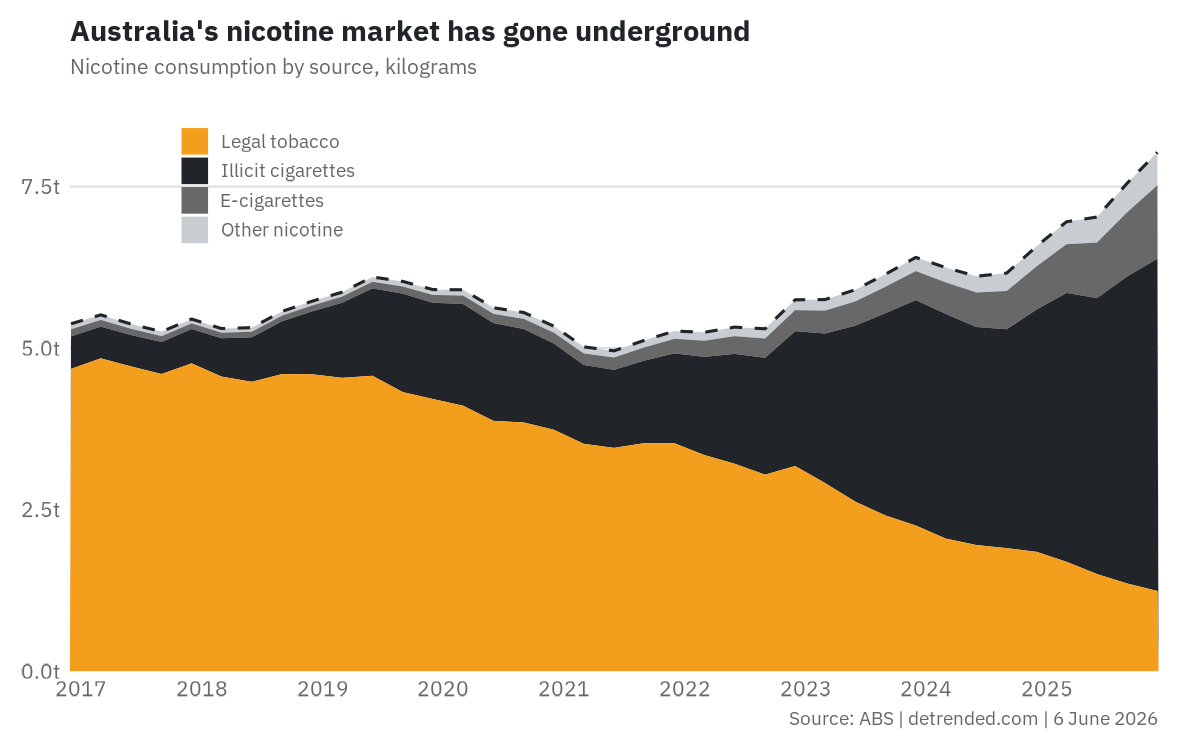
As much as 80% of all nicotine consumption in Australia in 2025 was illegal, up from just 10% in December 2016. It turns out that there is a Laffer Curve for so-called sin taxes, and Australia has well and truly blown through the top end of it.
Australia's Tobacco Commissioner might not believe that the high excise tax rate on cigarettes is driving the illicit market, but she's wrong. The fact that the ABS estimated price of an untaxed illicit cigarette has declined over the past decade, while legal prices have risen by 170%, is the key reason consumers have switched.
The consequences of such policy ineptitude will be more gangs, more organised crime, and more people smoking completely unregulated tobacco than if the legal market for cigarettes and vapes were competitive.
Now that organised crime has such a strong foothold, such an equilibrium won't be easy to unwind. But a good start would be to slash the tobacco excise tax by 80% (just the current excise of $1.50 is around 3x what an illicit cigarette costs) and align the political incentives by legislating that all Commonwealth tobacco-related revenue would flow to the states, given that they carry the health and policing burden.
Have a great rest of your weekend.


