
Efficiency or revenue?
Treasury defends the tax hikes; Australia's economy might be slowing down; and Budget fun across the ditch.


Good morning and welcome to Detrended, where it has always been about the revenue.
Treasury speaks up
I can't imagine Australia's Albanese government is feeling all that great about its now-infamous budget, given that earlier this week it felt the need to trot out Treasury Secretary Jenny Wilkinson to explain it to us plebs. Unfortunately for Labor and the Secretary, it didn't go down all that well; rather than convincing people of the importance of the budget's tax changes, Wilkinson managed to contradict what the Albanese government has been saying all along.
Remember how we've repeatedly been told the changes to capital gains taxes are about removing a "distortion" that disproportionately favoured property investment? It's about efficiency, not revenue. Yet in the space of a few minutes, Wilkinson conceded three points the government has been at pains to deny:
- There is "not clear evidence to support favourable treatment of capital gains to promote aggregate investment or savings".
- "The tax elements... are really a bit more about changing the distribution of housing ownership, rather than addressing sort of an overarching sense, supply."
- "Individuals are sensitive about paying additional tax, which is totally understandable, but revenue needs to be raised from somewhere."
The first assertion is highly misleading or outright false, which is disturbing considering this was a planned speech, not some slip-of-the-tongue during questioning.
As for the other two points, they run against what the Prime Minister and Treasurer have been saying all week: the capital gains tax changes are in fact all about revenue, and will do nothing for the housing market other than swap the deck chairs around a bit by changing the distribution of ownership. True tax reform seeks to raise revenue more efficiently at lower rates, which can't be true if Australians will pay additional tax on net following these changes.
It's times like this that I feel the need to stress that with government revenue as a share of the economy at record highs, Australia doesn't have a revenue problem, or even a debt problem. It has a spending problem.
Cooling off
Australia's economy is slowing down. In the past ten or so days, we've found out that in April unemployment ticked up to 4.5%, trimmed mean CPI came in at a softer-than-expected but still well-above target 3.4%, and headline household spending fell 1.1%.
By the time the household spending data dropped – the fall was driven by a 4.7% decline in transport as airlines cancelled flights, but was generally weak all around – the odds of a June rate hike all but evaporated and the Aussie dollar retreated.
It's hard to disentangle exactly what's causing what, given the multiple forces at play. For instance, is the war in Iran causing "ongoing price consciousness among households", as the ABS put it, or are the RBA's back-to-back rate hikes – with a third from May still to flow through – starting to bite?
Regardless of why, demand certainly seems to be cooling off with inflation still sitting comfortably above target. Slowing growth with sticky inflation is the one combination the RBA really didn't want, and, unfortunately, it looks like that's exactly where we're heading.
Budget fun across the ditch
Sometimes it's easy to forget that New Zealand exists. As a former resident I've certainly been considering making a move back, even with its rather dismal productivity performance and deceptive taxes on capital (there's no capital gains tax, but you do pay tax on 5% of the cost base of all listed foreign assets each year after being there for four years). Still, property is cheap compared to Australia, the Albanese government's changes to capital gains have closed the relative tax gap, and many parts of the country are quite nice indeed.
Anyway, the Kiwis' governing centre-right coalition released their budget last week. It was... not great. While there was some actual reform such as the removal of a tax on unrealised gains and doubling in the de minimis threshold for foreign assets (the one I described above), New Zealand has an even bigger spending problem than Australia.
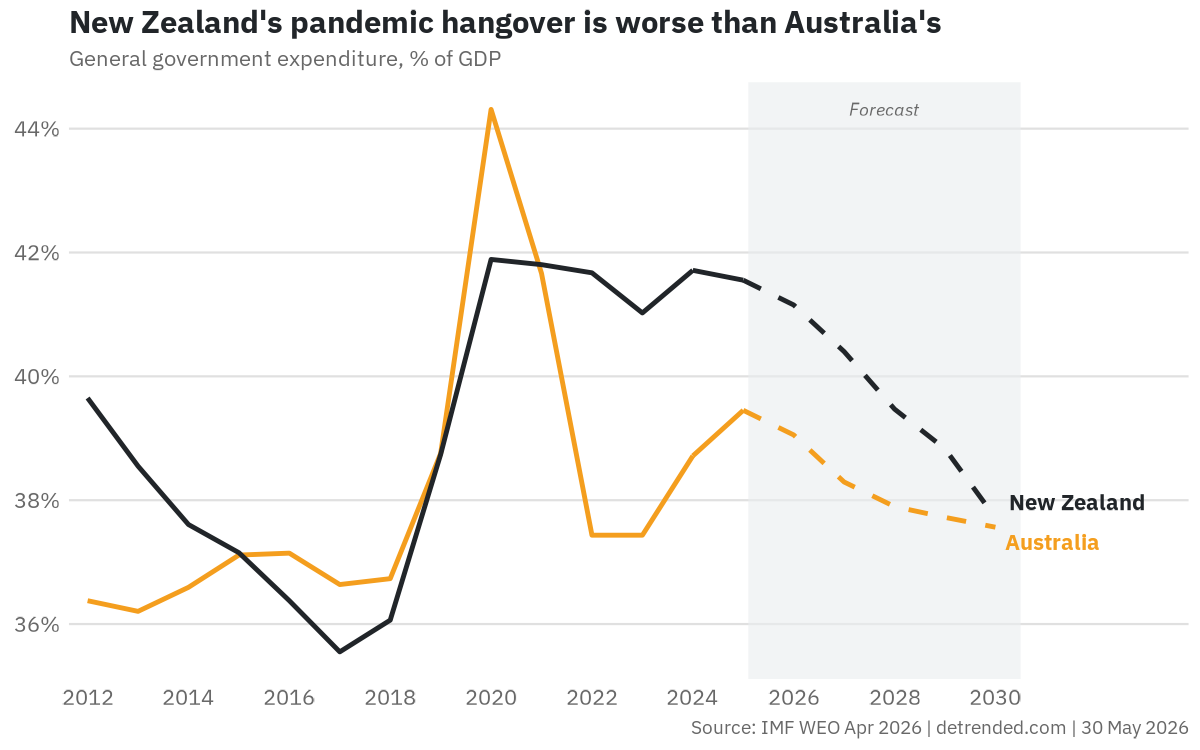
This is a government that faces an election in five months and was elected, at least in part, to repair some of the fiscal damage caused by the Ardern Labour government. Every budget it promises to do just that, yet actual government expenditure as a share of the economy has been stuck near record highs under its watch and the mythical surplus is always conveniently forecast near the end of the forward estimates.
As an interesting aside, one of the few pre-election policies the opposition has announced is a capital gains tax. Unlike Australia's, it will be quarantined exclusively to investment property. Bold reform, if your definition of reform is changing who owns the houses rather than building more of them...
Have a great rest of your weekend.


