
It's not about the water
The arguments against data centres are a classic Gish Gallop designed to rile up emotions and obstruct investment.


There has been a lot of talk about artificial intelligence and specifically data centres amongst the political elite. Critics claim they use too much water, or they'll push up your power bill. They may even take your job! The Greens have gone so far as to establish a Senate inquiry, as has the state of NSW. Independent senator David Pocock wants ministers to force data centres to "fully offset" their power usage, posting that with the speed and scale of the build-out, such a rule is "urgent".
But really, it's all a Gish Gallop: water, power bills, jobs, environment, sovereignty, community concern; it's all fired off in rapid succession to rile up emotions so that people don't have time to even think about what it all means.
Take water. I don't have much data for Australia, but US data centres consume roughly 150 billion gallons a year for upstream power generation, plus another 17 billion for cooling. For context, American lawns use 3,285 billion gallons. Almonds use 1,650 billion. Golf courses, another 1,000 billion. The bigger scandal is why agricultural water is priced so low that users consume so much of it to produce so little value: a 5-gallon water jug, by one calculation, produces around US$132 in economic output through a data centre versus about 2 cents through almonds.
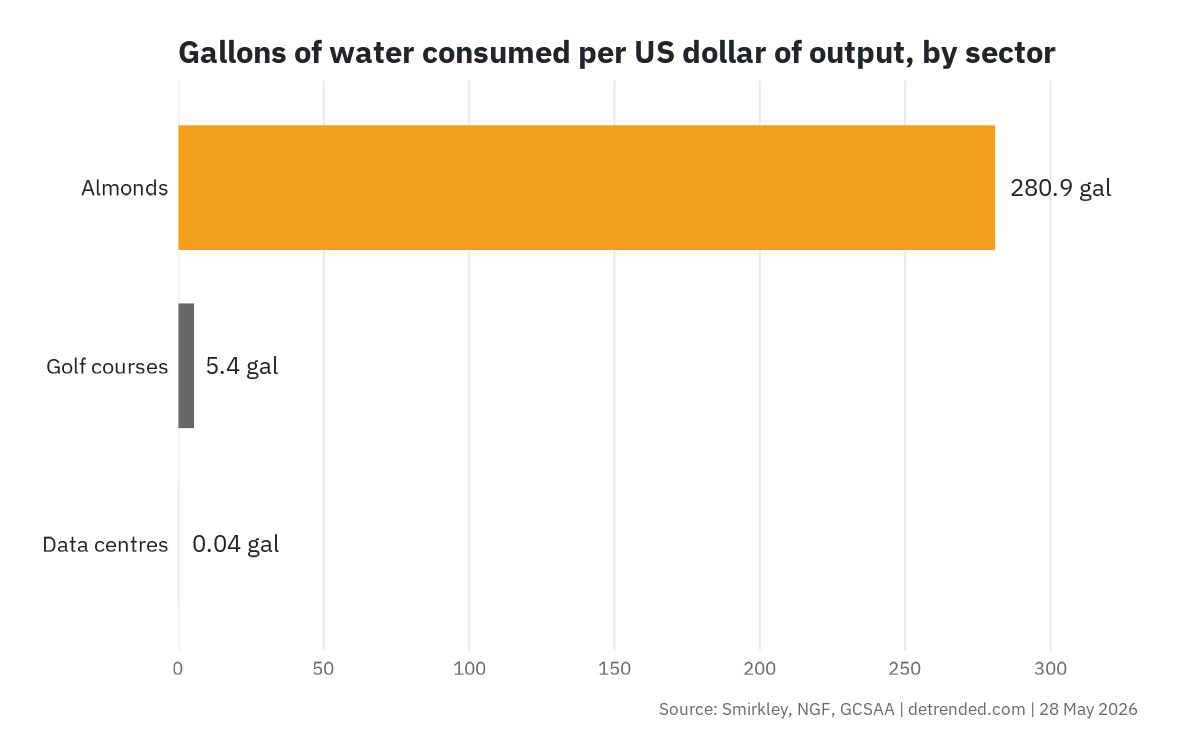
If water scarcity is a real concern, there's a textbook solution: raise its price. That incentivises conservation – only the most profitable users stay viable – and gives the utility a reason to expand supply, whether through a new reservoir or desalination. If you're worried about rising household bills, target them directly (on balance sheet, too!) rather than messing with the entire market.
The electricity argument is similar. The AI-specific portion of US data centre consumption is so small it barely registers against total US generation. More importantly, transmission – which is what's blowing up energy prices in Australia with the Albanese government's renewables rollout – is mostly a fixed cost that must be paid whether it ships 10 GWh or 100. Adding a large new buyer spreads those costs across more units sold, putting downward pressure on transmission tariffs for everyone. Following Pocock's "full offset" idea risks forcing data centres to subsidise additional, potentially inefficient generation, negating some of that benefit.
The local economic evidence runs the other way, too. A new NBER working paper by Alvarez, Argente, Chow and Van Patten found "positive effects on total employment, data-processing employment, construction employment, establishments, house prices, and electricity prices at different horizons after data center growth".
Electricity prices do rise locally, but the overall package is unambiguously good for the local community. PwC's recent work estimates US data centres supported 5.5 million jobs and contributed US$927bn to GDP in 2024, which is "as many total jobs as people who work in hospitals".
Speaking of jobs, AI may genuinely displace white-collar work faster than retraining and institutions can adapt, and that's worth taking seriously. But that has nothing to do with where the data centres sit. The models that might displace a copywriter in Parramatta exist regardless of whether the racks powering Claude are in Western Sydney or Johor. All blocking the Australian data centre will do is send the construction jobs, the grid investment, the tax base, and all the other local benefits somewhere else.
Australia has lots of what data centre operators are looking for, such as land, political stability, and, with any luck, relatively affordable renewable energy. But with Canberra hiking taxes on capital, and senators like Pocock essentially rallying the peasants and their pitchforks, Australia may well miss out. Investment decisions are being made today, not when the Greens' Senate inquiry concludes in November, and we all know that uncertainty is anathema to investment.


