
How to build a moat
Banning open-weight AI is just rent-seeking dressed up as national security.


Last week I wrote about how there's no moat for the creators of large language models (LLMs). By that I mean AI is rapidly becoming commoditised, entering an equilibrium where goods are barely distinguishable from each other, so consumers are largely indifferent between competing brands. Refined petroleum is a good example of such a good. When you go to fill up your car at the petrol station, do you really care if it's at Ampol or BP?
Now, that's obviously not exactly true for AI: using Claude Fable is certainly a different experience to using Kimi K3, and the flood of new products like "GPT-Live" are clearly designed to keep people tethered to the leading US model providers. But the gap in the underlying models is narrow, narrowing, and when you're looking to raise capital at a US$1 trillion plus valuation, you... should probably demonstrate to investors that you have a reasonably deep competitive moat to underwrite many years of free cash flow.
Enter the lobbyists:
"[L]eading AI labs or their allies [have been] approaching the administration every 3-5 months with an idea to ban open-source models."
There's no good reason to ban open-source LLMs (the correct terminology is open-weight – the source is very much still closed, even on Chinese models – but let's forgive the Axios reporter on that slip). Which is why people like Dario Amodei and Sam Altman, the Anthropic and OpenAI CEOs, respectively, have been AI doomers for years now.
Safety. Fear. Two words that have been a lobbyist's wet dream since the founding days of the United States.
If the creators of closed weight LLMs can scare regulators into believing that all models pose some kind of risk to people's safety, or even better "national security", it's not a huge leap to imagine them writing some kind of DRM-like licensing protection system, and requiring US companies to use only approved, certified, verified, and fully censored, "Made in America" models. Even smaller US competitors would get swallowed up; complying with whatever regulations are enacted will be a much smaller share of revenue for the likes of Alphabet, Anthropic, and OpenAI, helping them secure market dominance.
The US government could then browbeat its major allies into following suit, and suddenly most of the world's major corporations will be forced to pay over the odds for American AI, much of which will be pure economic rent, i.e. socially wasteful, because it's not what many of them want to do.
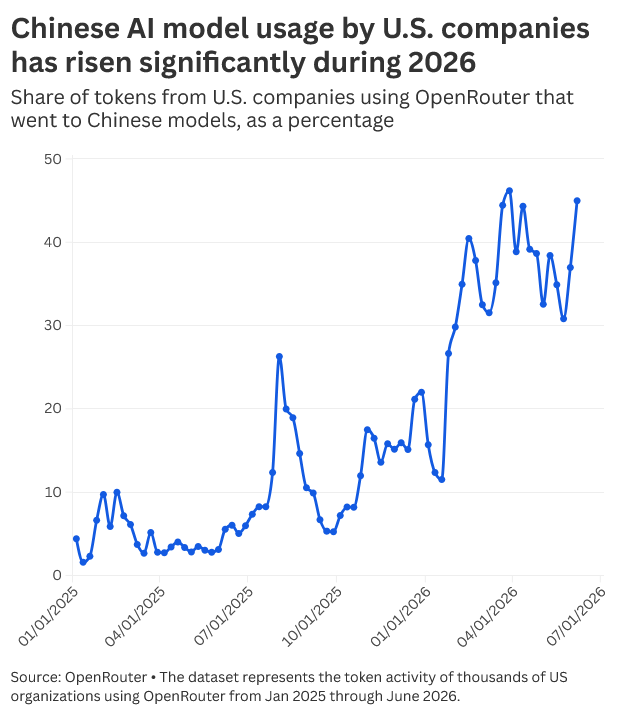
Yes, there are real data-sovereignty questions about piping corporate queries through Chinese-hosted models. But open-weight models can be hosted anywhere, and that's an argument for procurement rules, not for banning the weights or constructing an AI licensing regime.
That would have negative implications all the way down the stack, too, reducing competition in chip manufacturing, data centres, cloud operators, and software providers (e.g. OpenCode vs Claude Code).
There are two ways I see this playing out. One is that the US government ignores the siren song for a regulatory moat and instead opts for a 'light touch' regulatory regime, falling back on existing laws that already protect people against hacking, scams and other methods of attack that LLMs will inevitably scale. For me, that's the best-case scenario for the world's consumers, because it will maximise competition, innovation, and therefore productivity and growth.
But it will also mean a lot of wealthy and politically powerful early investors in Anthropic and OpenAI may be unable to exit at levels they were hoping. To the extent that the financial sector has got itself involved in the whole racket, any correction could cascade into something much more severe.
The second option is that the US government does build its leading LLM providers some kind of "model welfare" moat, in the form of regulation or prohibitions on open-weight models (both at home and overseas). Trump is very much an interventionist, and loves a "winner", so I could see him being persuaded by the idea of enabling another trillion-dollar US company or two, even if it comes at a much greater cost to the world economy.
Perhaps the only thing preventing such an outcome is that there's no fire; for all the scaremongering about AI, there's still little evidence it's actually doing any of the things the merchants of fear have been trying to sell us. Hopefully his advisors are wise enough, or not sufficiently on the AI take, to see through the smokescreen. David Sacks certainly is, but he was eased out of Trump's AI tsar role in March, so presumably has less of an influence these days.


