
Labor's poison pill
The Greens got their concessions, Labor got its tax hike, and the rest of Australia got a revenue grab dressed as neutral reform.


Well it finally happened. Labor's controversial capital gains tax (CGT) "reforms" are set to sail through Parliament courtesy of a dodgy deal with the Greens. I'm calling it dodgy not because of the substance – in exchange for their support, the Greens blocked the ability for superannuation funds to borrow to buy property and had an inquiry into the proposed NDIS cuts extended by another 8 weeks – but because of the hypocrisy.
When the Hawke government first introduced the CGT in 1985, it followed an intensive ~9-month period of public debate, political negotiations, and a televised National Tax Summit. Similarly, when the Howard Government was considering reforming that to a simpler 50% CGT discount, it discussed and developed it over a period of roughly thirteen months, culminating in a Review of Business Taxation (Ralph Report), before passing it into law.
You would think, given how potentially consequential these proposed CGT changes are, that Labor would have done something similar. Or that the Greens, who supposedly "demand" transparency, would have made their support conditional on something more substantial than two days of debate. If the proposed NDIS cuts deserve significant public scrutiny, why not major changes to the tax system?
That's obviously rhetorical; I know the answer is that the Greens will ultimately vote in favour of any change that raises taxes, while fighting anything that cuts spending (unless it's on things like defence and non-renewable energy). But it's still hypocrisy that should be called out.
So, Albo and Chalmers will get their tax hike. They plugged a few glaring mistakes such as secret death taxes, appeased a few interest groups with some minor concessions that will be a bureaucratic compliance nightmare for anyone actually wanting to use them, and bribed the Greens into compliance. Job done.
But take a step back from the politics and the economic outcome becomes relatively straightforward: in Chalmers' words, "rebalancing" the tax treatment of capital towards that of labour will weaken the incentive to save and invest. Don't just take my word for it; there's a strong tradition in the optimal-tax literature that capital should be concessionally taxed, if at all. Labor's own Henry Review literally stated that "comprehensive income taxation, under which all savings income is taxed the same as labour income, is not an appropriate policy goal or benchmark".
The simple fact is if you tax the return to building capital you get less of it, which means a smaller capital stock, i.e. less equipment and machinery per worker, and lower productivity. Workers are more productive when there's capital behind them, so a thinner capital stock eventually shows up as lower real wages. And because capital is mobile in a small open economy like Australia's, it very quickly goes elsewhere when the after-tax return falls, leaving labour to carry even more of the burden.
I would have supported the indexation of capital gains if it was actually about removing the "distortions" that Chalmers likes to harp on about. But because of the 30% rate floor, the lack of indexation for losses, and no income averaging to prevent people with lower lifetime incomes being propelled into the top tax bracket in a given year, it's clear that the goal is revenue, not efficiency: a genuine tax neutrality reform restores indexation and averaging, and therefore has no need for a rate floor.
So, where to from here? Now that Labor's tax hike will be legislated, the billion-dollar question becomes whether it will be politically durable. Polling suggests that Labor's method and actions have been deeply unpopular with voters, with right-wing parties pulling ahead since the changes were announced.
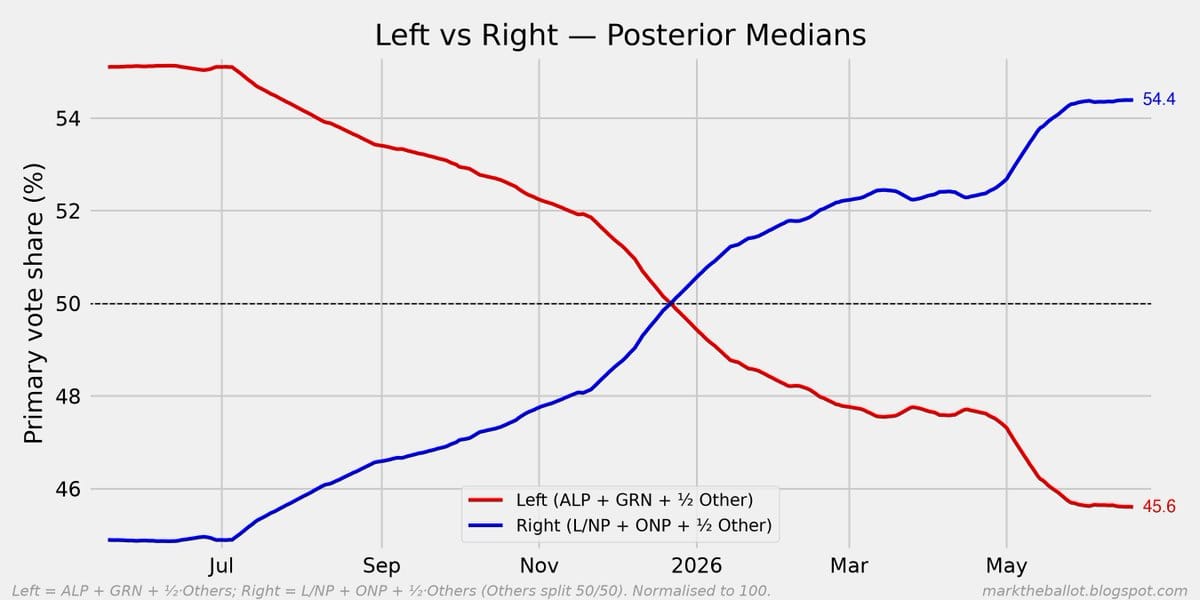
But politicians are loath to repeal a tax hike when their opponents had to do the heavy lifting to get it passed, making this something of a poison pill. Australia's structural budget deficits will eventually need some combination of tax increases and benefit cuts to solve, because let's be real: it's a fantasy that growth will bail us out when our governments are actively passing anti-growth "reform" such as this.
Also working in Labor's favour is the fact that no one will pay a cent of extra CGT until after the next election. Lots can change in two years, so Labor will no doubt be hoping that voters have short memories and, when the time comes, are willing to trade off long term prosperity for an inevitable pre-election sugar rush in the form of debt-financed handouts.
That all suggests that once it's legislated Labor's tax hike could prove to be quite politically durable, and future Australia will be slightly less wealthy because of it.


