
Treasury's imaginary gift
Indexing for inflation isn't a concession, and deferring tax until you sell isn't a loan.


The Albanese government's deeply unpopular capital gains tax hike bill is working its way through the Senate, where it needs to secure support from the Greens to become legislation. As part of that process a Committee has been asking a bunch of questions, including to the boffins at Treasury who presumably came up with the idea.
So how exactly did Treasury justify what appears to be deeply flawed "reform"? According to senior officials Diane Brown and Shane Johnson, the changes are no big deal because capital will still be concessionally taxed relative to wages even after the 50% discount disappears, because any gains will still be taxed at realisation rather than as they accrue. Johnson specifically described the deferral of tax until realisation as an "interest-free loan" from the government.
There is some truth to that. If you defer tax until you sell, you will certainly do better than handing it over every year, because the money you didn't pay stays invested and compounds. Score one for Treasury.
However, deferral is only equivalent to an "interest-free" loan if you accept the premise that capital should be taxed on an accrual basis, i.e. "every year". Treasury is implicitly making the assumption that accrual-based taxation is the natural baseline against which to compare policy, and it's only because of the government's generosity that you're not having to pay tax every year on all of your unrealised gains.
Hence, according to Treasury, the changes are still a "concession".
But that's not at all consistent with the economic literature. Picture two people who earn the same. One spends it now, while the other saves and spends it in ten years. Tax the return on the bank balance and the saver ends up with less than the spender, purely for being patient. It's effectively a tax on waiting, and that's really bad for economic growth, productivity, and real wages.
Indeed, that distortion is one that economists have spent decades trying to design out of the tax code, not defend. The comprehensive Mirrlees Review's central recommendation was to stop taxing the normal return on saving and investment altogether and tax only the excess above it, going as far as leaving ordinary bank deposit interest untaxed. Other seminal work suggests that if the government has a decent set of other tax instruments available, as Australia does, then the optimal tax on capital is closer to zero.
So Treasury basically has it backwards. When you can defer realisation of unrealised capital gains, as you can in Australia, the capital tax regime accidentally behaves more like an efficient consumption tax, easing the penalty on saving it should never have been taxing in the first place.
As for the idea that capital gains income is still receiving "concessionary" treatment under these changes when compared to wage income, Treasury's own assumptions show how bogus that claim really is.
Just think it through. Treasury is proposing to index the cost base, which is an admission that inflation drives nominal gains above real ones, and only real gains should be taxed. So far, mostly good (removing the inflation distortion still taxes the normal return that, ideally, shouldn't be taxed at all). But then it makes the leap that being taxed on real income is a "concession" capital enjoys over wages, because the latter is taxed on "nominal" income. But that's just flat out incorrect: the treatment is exactly the same, because there's no inflation to strip out of wages; dollars earned today are already real dollars!
The only other point I'll give Treasury is that unlike capital, a worker can't defer tax on a salary the way a long-term investor defers it on a gain. You can solve that with income averaging, a feature of the pre-1999 system the Albanese government, perhaps on Treasury's advice, decided not to include in its reforms.
I don't know what's going on at Treasury. Institutional decay doesn't happen overnight, but it can and does happen. Since the Albanese government came to power, the public service has expanded by 43,000 people (~31%), some of whom are no doubt at Treasury. Is that why it first came after unrealised gains via the Div 296 raid on Superannuation, and now it's gunning to hike taxes on all capital outside of retirement funds? Have the economists left the building, leaving the accountants to call the shots? I honestly can't think of any other reason why it's so keen to tax capital, when capital accumulation is essential for productivity growth and Australia is in dire need of it.
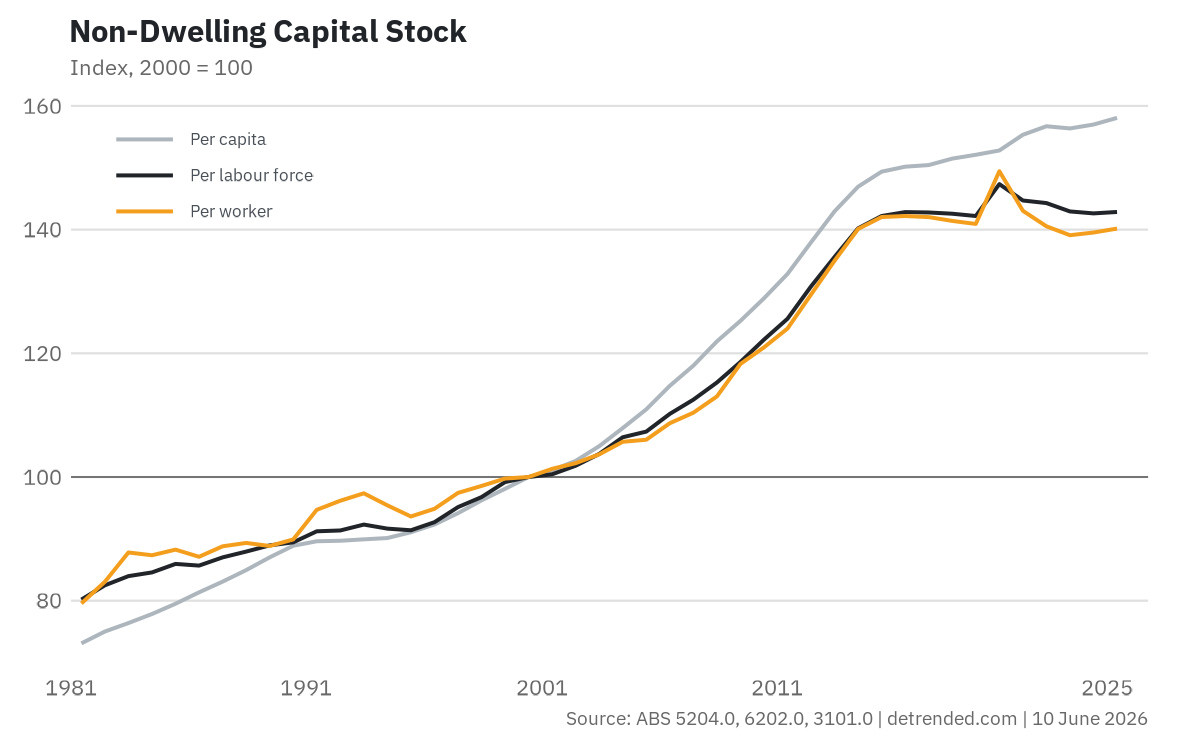
The only way to defend these "reforms" is to say that the government wants revenue, and capital is easier to tax than wages, at least in the short-run; capital is highly mobile so high capital taxes will eventually thin out the capital stock, reducing long-run wages and revenue. That's the honest argument, and it's the one Treasury should have made, rather than this nonsense about "concessions" and deferral being equivalent to an "interest-free loan" from our oh-so-generous government.


