
Australia should legalise nuclear
Belgium, Germany, Denmark and Japan are reversing course. Yet Australia is still pretending it has a choice.


Australia's coal-fired power plants (still more than 40% of national energy generation) are rapidly aging. State governments are repeatedly piling cash into them to extend their life because no private owner would put their own capital into a condemned asset.
Australia is all-in on renewables, but its isolated grid makes that a challenge. Sure, it can load up with batteries and grid-forming inverters, but to achieve stability it would need to overbuild to what would be a staggering amount of waste in most situations.
Gas is a decent solution, if you can get it. Australia is already pumping whatever the pipes from Gladstone can handle, and its only import terminal has yet to open. New gas turbines have wait times of nearly a decade, and cost far more than net zero plans assumed. Everyone wanting the same firming solution at the same time, predictably, drove prices up.
The good news is there is another proven dispatchable low-carbon technology: nuclear. And honestly, I don't think you can call yourself 'green', or 'for the environment', and not want to use nuclear. If your goal is to provide affordable, stable power and move the needle on carbon emissions, nuclear is the cleanest and safest form of energy generation there is.
The Europeans are finally waking up to this uncomfortable reality. Belgium's parliament repealed its 2003 nuclear phase-out law in May 2025 and is now nationalising the fleet from Engie, with a target of doubling capacity to 8 GW by 2035.
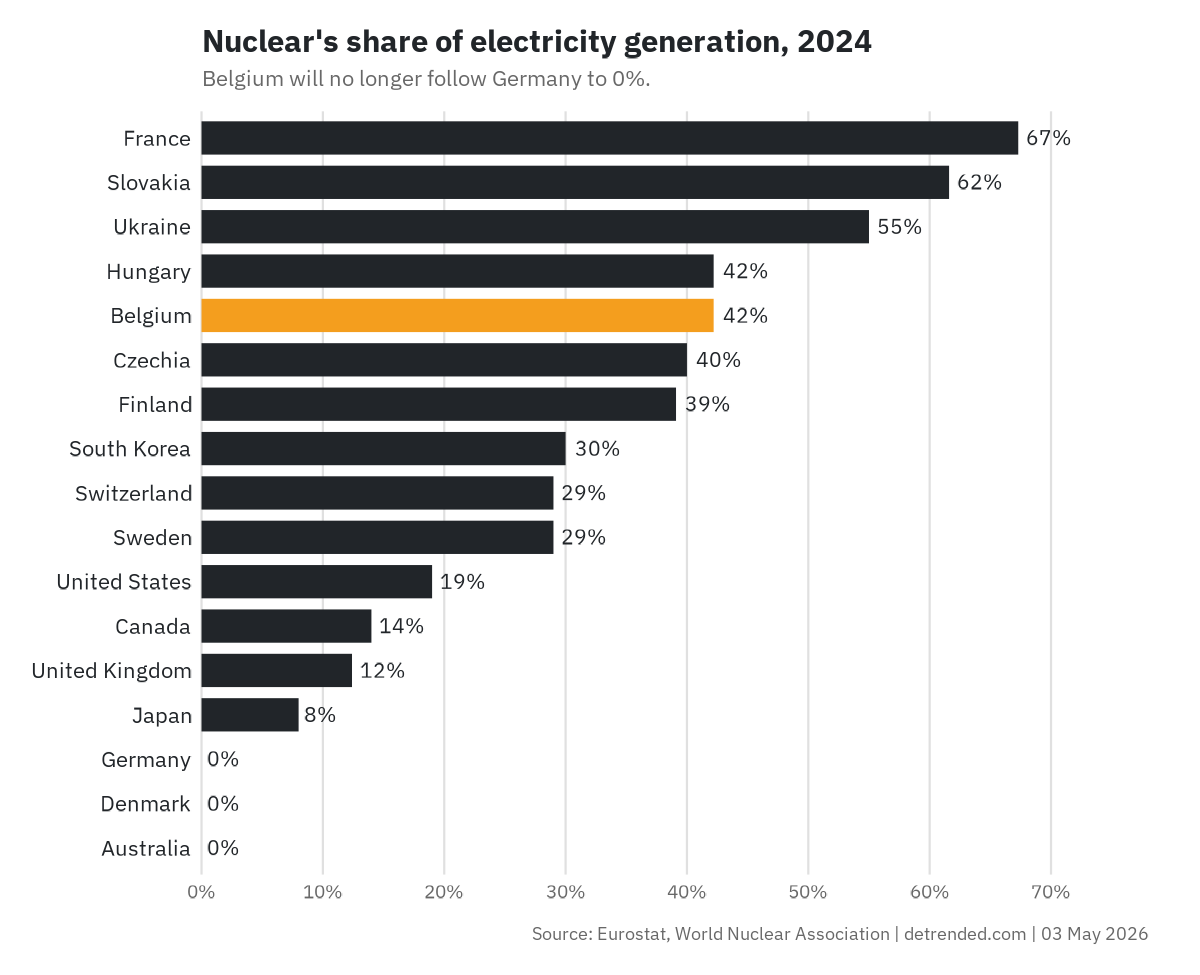
Germany's chancellor, Friedrich Merz, called his country's phase-out a "serious strategic mistake", while the IEA's Fatih Birol went further, calling it a "historic mistake". Denmark's parliament voted overwhelmingly (two-thirds) to study lifting its 40-year nuclear ban. Japan keeps restarting reactors, displacing gas power. The US, Canada and France never stopped.
The technology hasn't changed. What's changed is that the cost of intermittency became legible the moment cheap Russian gas stopped firming Europe's grids.
Australia faces a similar renewables firming problem. AEMO's Integrated System Plan assumes the coal fleet retires through the early 2030s, with the gap filled by renewables, transmission, storage and a substantial amount of gas. Whether the gas portion is feasible at the scale (and cost) assumed is an open question that becomes more questionable by the day, with local populists increasingly trying to kill the industry entirely.
To hedge its bets, Australia should legalise the only other proven dispatchable low-carbon technology: nuclear power. Sure, it might not be the right option for Australia. But we'll never find out under a blanket prohibition.
Lifting the ban doesn't commit anyone to building a reactor. It just lets the economics decide, project by project. It would cost almost nothing and foreclose no option.
It's hard to think of another resource where Australia's policy stance is this incoherent. It exports the input (uranium), bans its use, then frames the ban as environmentally responsible while everyone who imports it either uses it or is moving back towards using it. The countries Australia sells uranium to are telling it, with their own policy reversals, what they think the answer is. Legalise it!


