
Australia still has an inflation problem
Australia's domestic inflation, the poor incentives behind green energy transitions, Australia's new oil refinery, and Argentina's ongoing recovery.


The rate of annual growth in Australia's measured inflation fell a little to 3.8% in June (from 4.0% in May), obliterating any chance of an August rate hike. But the Reserve Bank of Australia (RBA) won't be entirely comfortable with what it's seeing as the slowdown was entirely due to tradeables like energy (remember that brief pause in the Iran war?), while domestically exposed prices continued to rise.
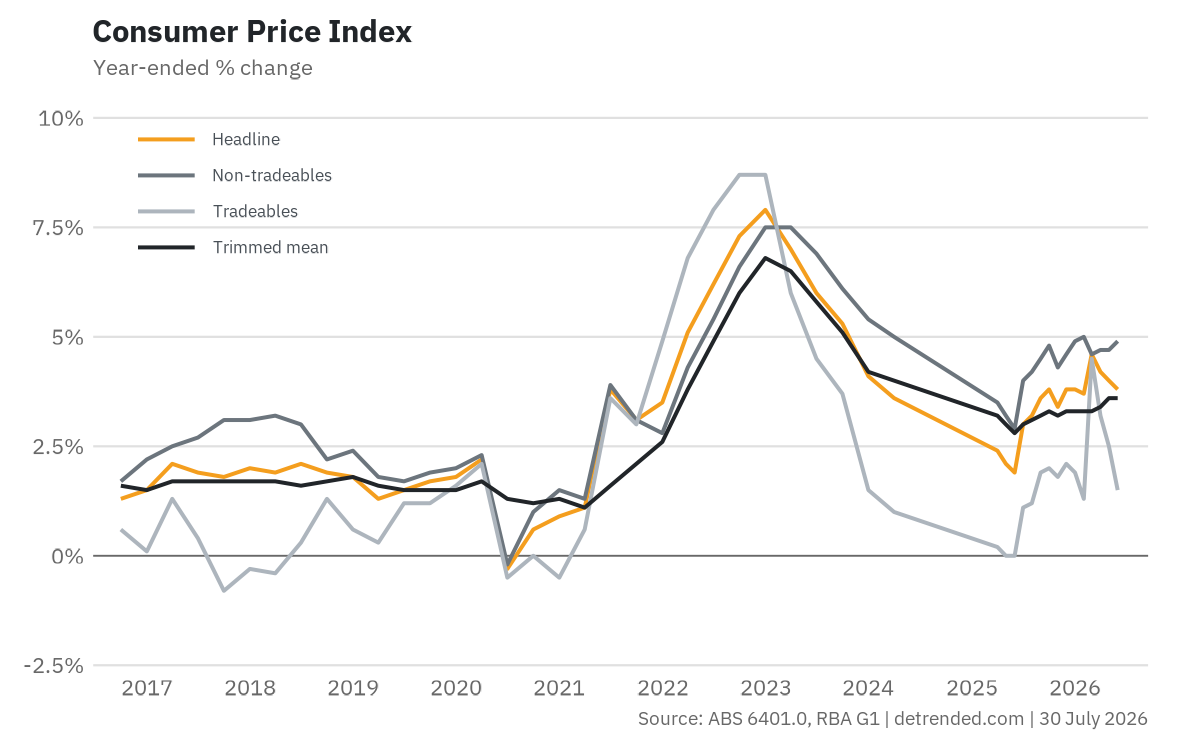
Australia still has an inflation problem. The RBA will hold in August, but if rates do move again it's difficult to see it happening in any other direction than up.
The cost of green bliss
Economist Timothy Taylor highlighted a new collection of essays about Europe's adventures with its "Green Deal" that could easily double as an Australian case study. For example, Germany:
"Launched in the early 2000s, Germany's Energiewende has long been seen as a model for large-scale renewable energy transitions. By rapidly expanding solar and wind power, Germany aimed to replace both nuclear and fossil fuels, inspiring the European Green Deal and its goal of EU-wide carbon neutrality by 2050."
According to the study, the Energiewende has left "Germany with the highest household electricity costs in Europe, around 40% above the EU average".
Higher electricity prices are a recurring feature of green transitions. This isn't because green energy inherently costs more, but because policy design is driven by expressive political behaviour rather than efficiency. Citizens embrace "bliss beliefs" that signal virtue, while politicians respond to those "expressive preferences". Dissent gets stigmatised, leaving us with "emotionally salient but economically inefficient outcomes":
"[T]he design and implementation of Green Deals are almost never guided by neutral efficiency considerations alone. Instead, they are deeply shaped by behavioural dynamics biases, heuristics, and expressive political behaviour—which distort both citizen preferences and policy choices."
As for a Albo's signature Future Made in Australia policy, well:
"[I]nstead of stimulating productive entrepreneurship, state-led industrial policy opens abundant opportunities for 'plunder' by well-connected insiders ('Bootleggers') who exploit the state's moral legitimacy, often provided by well-meaning 'Baptists' advocating the common good."
If you don't think that's happening all over Australia, let me introduce you to the state of Victoria [paywall-free mirror].
National security as a subsidy honeypot
Western Australia is probably getting an oil refinery, ostensibly for national security. That's because there's virtually no chance that it ever comes close to paying its own way; BP's Kwinana Oil Refinery shut down in March 2021, citing "sustained low refining margins".
While the location is to be determined, one thing it has going for it is it'll likely be located in the North West. Albo announced the project during a visit to Karratha, and the firm lobbying for it, Perdaman, has industrial projects located up there. It's also where the state's oil is located, and being a new build means it could be tailored to the North West Shelf's light crude oil and gas condensates, solving some of the problems that the old Kwinana refinery faced.
But there's a reason firms like Perdaman are lobbying the government for this. It's because they don't think it's economic without generous subsidies. If they did, they'd already be doing it. They're looking to exploit the current Iran crisis to plunder themselves a new refinery they can use to support their new urea plant in Karratha, which is already set to benefit from subsidised natural gas due to the state's reservation policy.
National security is a ruse. In a major crisis, would having a third local refinery help? Yes, at the margin it would slightly reduce the quantity of refined product needed to be imported from Singapore. But to know whether it's worthwhile, you must do a risk assessment that includes the benefits and costs. If you don't do that, there's no end to the amount of projects that government should subsidise in the name of national security. Cars? Computers? Pharmaceuticals? Machinery? Solar panels? We should make it all here, just in case there's a crisis that shuts down trade routes!
File this into reason #57,360 of why Australia's productivity growth barely has a pulse.
Argentina's recovery
Argentina may have lost the FIFA World Cup final, in no small part because Spain's European style of football (68% possession!) was simply too good for them. But its economy appears to be on firmer ground:
"Moody's upgraded Argentina's dollar bonds and revised its outlook from stable to positive this week. That was the third sovereign ratings upgrade for Argentina in less than three months, following Fitch in May and S&P Global in June.
...
This change is not magic or luck. Moody's noted that Argentina's 'macroeconomic stabilisation has advanced beyond the initial adjustment phase into a more durable improvement in credit fundamentals.' Booming exports have also improved the country's prospects, partly due to an expansion of the energy sector."
Economic reform can be painful for those who benefited from the old regime, and voters don't necessarily feel or notice the benefits of a more stable fiscal regime, at least not in the short-term. President Javier Milei, who faces election in October 2027, will be hoping the economy can continue to improve ahead of what looks to be a tight race against the Peronist opposition that ran Argentina into the ground in the first place.
Have a great rest of your weekend.


