
Caveat emptor
Pauline's big day, Hormuz is open (or is it?), and the biggest meme stock of all-time.


Good morning and welcome to Detrended, where this week buyer beware is the name of the game.
Pauline's big day
For the first time in her 40-year political career, One Nation's leader Pauline Hanson delivered an address to Australia's National Press Club. She wasted no time in hitting on perhaps the key reason why people are flocking to her once-fringe party:
"Australians' trust in the media, the government and public institutions is at an all-time low. To you, the media, may I offer some advice – you have to earn the trust of the Australian people."
There's a very deep well of distrust in Australia. In 1977 the leader of the Australian Democrats, Don Chipp, coined the slogan "keep the bastards honest", securing the party an unusually high 11.1% of the Senate vote and a presence in the Senate for the next 30 years.
After the cartoonishly dishonest and secretive Morrison government, the Australian people flocked to Labor leader Anthony Albanese after he cleverly campaigned on the idea that his word is his bond. But he has, lie by lie, killed off his transparency and honesty credentials, most recently with his attack on capital gains tax and negative gearing.
It's safe to say that the well of distrust has been completely replenished. And when the Bondi attacks happened, it laid the perfect groundwork for an anti-immigration, anti-woke but brutally honest politician like Pauline Hanson to move into the mainstream. It might not be One Nation's slogan, but Hanson is clearly singing from the same sheet as Don Chipp.
The fact is Australians are tired of the endless stream of empty platitudes that flow from the mouthpieces of the two major parties; of the condescension, such as when Treasurer Chalmers said this week that "we have made some good progress" on inflation, more than four years after forming government. There are long and variable lags, but they're not that long; Reagan and Volcker brought the persistent, deeply-ingrained double-digit inflation of the late 1970s down below 4% within three years. In Australia, Hawke/Keating along with Bernie Fraser also managed to stomp the inflation cockroaches, bringing it down from nearly 7% to a sustainably low level within two years.
The public might not be economists, but they know that the inflation buck ultimately stops with the government, just as they know that it's the government that controls immigration.
The Albanese government was gifted a second term by Donald Trump. It's now trying to gaslight the Australian public into thinking a tax hike is in their interest, and lie to them by pretending inflation has nothing to do with its addiction to spending, or that its reforms of the central bank – which saw Chalmers hand-pick union insiders to sit on the monetary board – hasn't been an abject failure, with Australia one of the only countries having to hike rates back up in 2026.
Put it all together and despite a largely incoherent and potentially ruinous policy package, Pauline Hanson's One Nation now looks like a credible alternative to a lot of people who are asking themselves, how much worse could it be than another three years of the current mob?
Hormuz is open!
Or is it? After announcing his "deal" with Iran – which, let's be honest, was more of a surrender – Donald Trump promised that the Strait of Hormuz would be "completely opened" by Friday. Well, it's now Friday and the deepest prediction market is still only showing even odds that the Strait will be back to pre-war traffic by the end of July this year.
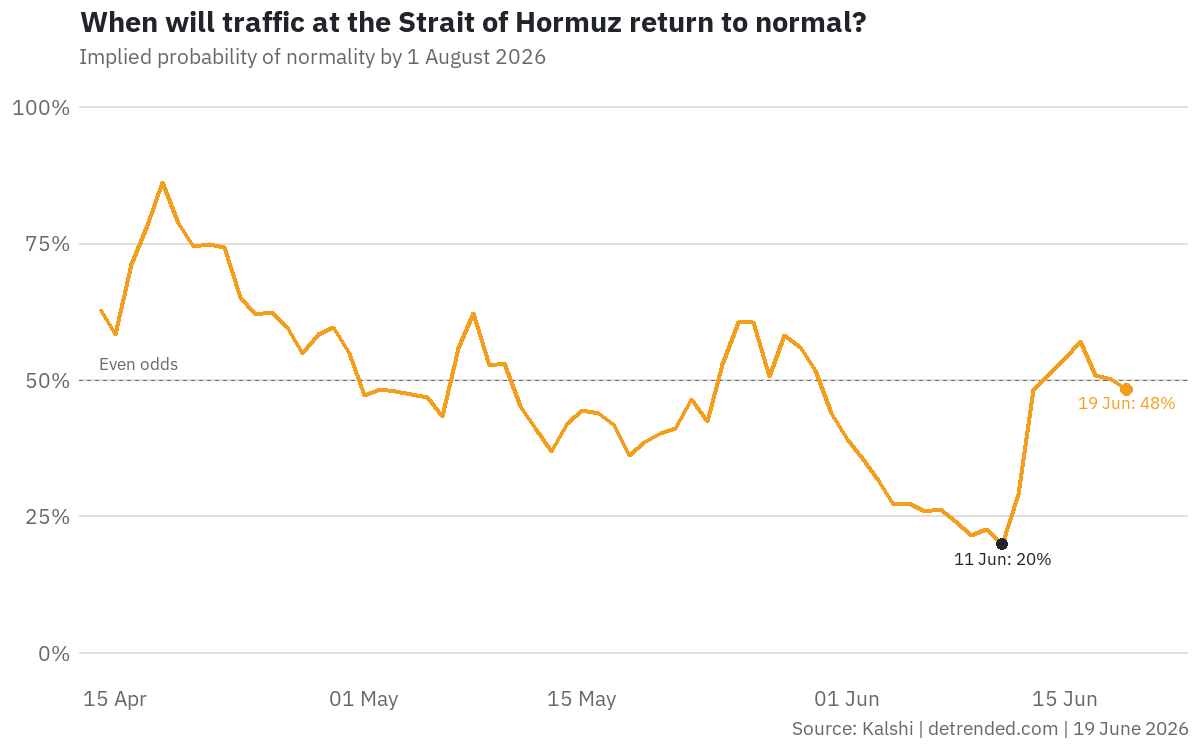
That's certainly better than it was last Friday (~20%), but it suggests that even if the Strait is "completely opened", we're not likely to see normal levels of traffic traversing it for some time.
There are a few possible reasons for that. The most obvious is that the Strait isn't actually completely open, as claimed by Trump. Perhaps Iran is charging tolls (sorry, "fees for services"), or there are still mines blocking parts of it. Another possibility is that the routes oil was using to escape the Middle East during the conflict are so robust that there's just no need to divert back to tankers on the Strait, at least not until demand picks up. Which brings me to yet another possibility: that some of the demand destruction that occurred during the conflict, for example due to substitution or changes in consumption patterns, will prove to be durable.
Whatever the case may be, any resumption of traffic is undoubtedly a good thing for many of the world's ailing economies, and that outcome now looks very likely. There's plenty of emergency supply restocking that will need to happen in the coming months and years, but Brent crude oil prices are now only ~7% above pre-crisis levels, which should start easing pressure on households and businesses in the near future.
The biggest ever meme stock?
Remember GameStop? The original meme stock, the struggling brick-and-mortar gaming retailer saw its share price shoot up from around US$1 to as high as US$120, before crashing back down to Earth and rising back up again multiple times. The driver of that volatility was retail investors who didn't care about fundamentals but were buying to squeeze short sellers and, hopefully, get rich quick in the process.
Those who got out in time did well, while many of those left holding the proverbial bag essentially lost their life savings.
I don't know about you, but I'm getting strong GameStop vibes from SpaceX. For whatever reason, people can't get enough of it. Even Australia's richest person, mining heiress Gina Rinehart, got involved: her company reportedly snapped up a cool US$1 billion worth of SpaceX during the IPO.
As for the company itself, it's becoming more of an AI business than anything to do with space. Sure, it launched lots of rockets and has a vast broadband satellite network, and people are no doubt betting that if the space frontier opens up, SpaceX is primed to dominate it. But the direction it has been moving in recent years is almost entirely AI: it acquired xAI, has enormous data centre capacity, and only a couple of days after becoming public it agreed to buy Cursor – an AI IDE (Integrated Development Environment) – with nothing but $60 billion worth of stock, or around 2.3% of its market cap. Its own prospectus stated that 93% of its projected market opportunities were AI-related, with most of that in "enterprise applications".
Can the insanity be sustained? Many a short seller has been destroyed by betting against Musk companies in the past; he truly is the hype master, able to sustain valuations well above fundamentals seemingly indefinitely by constantly promising to own the future. Perhaps he can do the same with SpaceX, or perhaps it will crash and burn (insiders can start selling after its Q2 earnings drop in August). I don't know, and neither does anyone else. But as far as risk goes, SpaceX ticks almost all the boxes: caveat emptor!
Economist John Maynard Keynes is alleged to have remarked that "markets can remain irrational longer than you can remain solvent". When it comes to SpaceX, that certainly seems like an adage that's worth keeping in the back of your mind.
Have a great rest of your weekend. Please note that due to travel, posting will continue to be less frequent than usual until early July.


