
Is Australia a high-taxing nation?
No, but tax-to-GDP is a highly misleading measure of the true tax burden.


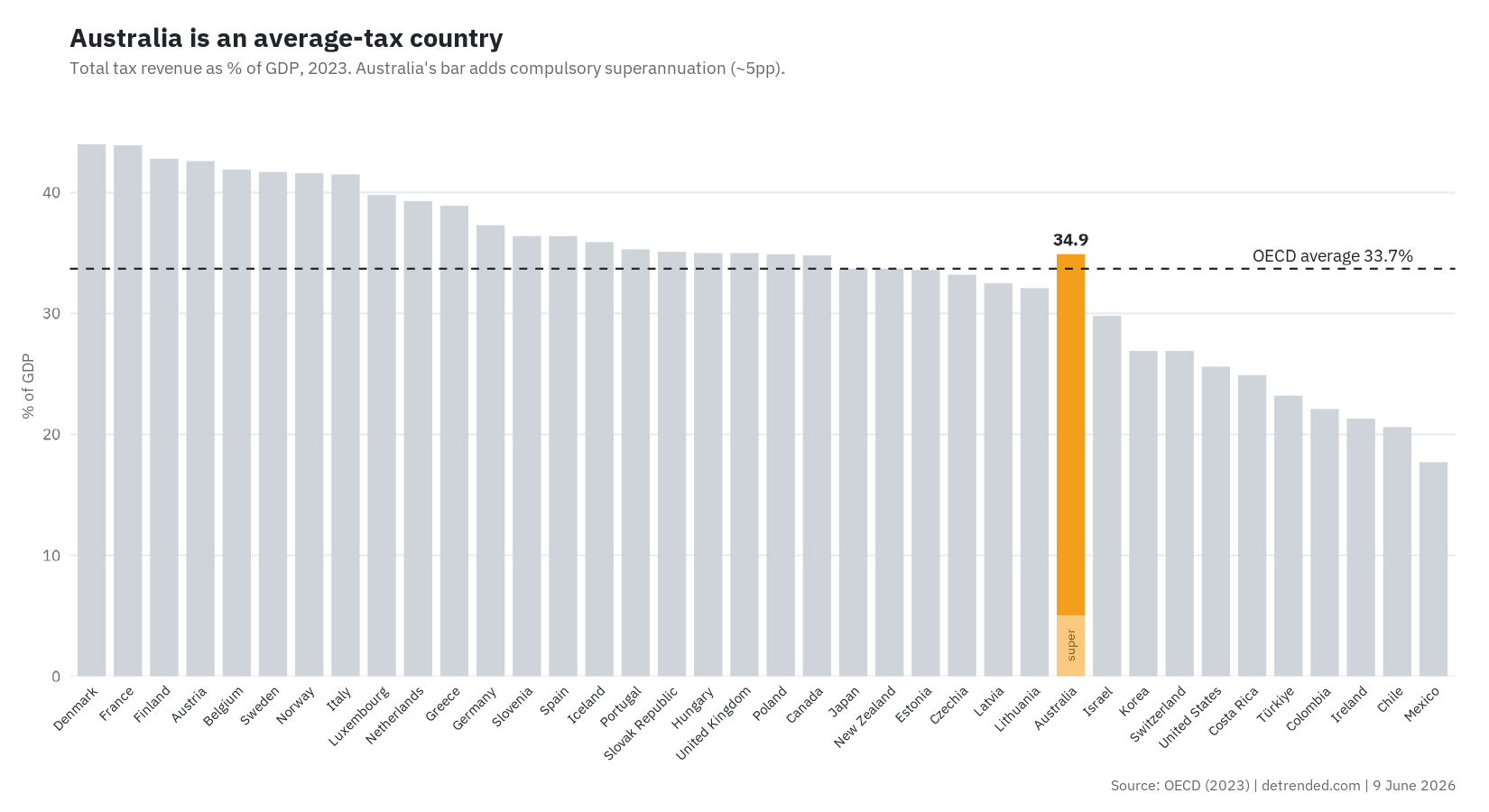
Australian property developer John Symond told ABC's 7.30 that Australians are overtaxed. Former Labor minister Craig Emerson fired back, citing Australia's tax-to-GDP ratio of 29.9% in 2023, which ranks it 28th out of 38 OECD nations, well below the 33.7% average and miles behind Denmark at 44%. On that measure, Emerson is correct: Australia is a low-taxing country.
Except that measure is highly misleading.
The OECD's tax-to-GDP figure counts social security contributions (SSCs) as tax. Australia doesn't have SSCs in the European sense, but it does have compulsory superannuation at 12% of wages, which is economically equivalent to a payroll tax earmarked for retirement.
The OECD excludes it because the money flows to private funds rather than government coffers, but it's close enough to a tax that it should be included. Do that and Australia's tax burden rises by roughly 5 percentage points, to around 35% of GDP. In other words, it taxes a bit above the OECD average, not 4 points below it.
But the comparison gets all the more uncomfortable when you think about why taxes are collected in the first place: to provide people with benefits greater than the cost of the taxes themselves. The benefits are things like social protection, health and education, while the costs include deadweight losses (mutually beneficial trades that never happen because of taxes) and opportunity costs (what someone might have done with their money if it wasn't taxed away).
So, what do Australians get for their costly taxes?
Perhaps it's easiest to start with the gold standard: high-taxing Nordic nations. Other than Denmark, their tax burdens are all around 7 percentage points greater than Australia's on a like-for-like basis. For that premium, the state provides free university, capped and heavily subsidised childcare, subsidised aged and social care, more than a year of paid parental leave for men and women, and extensive skill retraining programs. It's cradle to grave insurance type stuff; their citizens aren't forking out their hard-earned for education, private health cover, or aged care, because the state already does.
When you think about it, Australians don't pay all that much less in tax yet receive something closer to the US model of public service provision. Medicare and the PBS are genuinely good, and the university HECS model is significantly better than US student loans. But childcare is expensive even after subsidies, aged care increasingly requires a substantial private contribution, more than half of households carry private health insurance on top of the Medicare levy because the public system rations elective care through waiting lists, and something like 40% of Australian kids are in private schools.
I guess what I'm saying is it doesn't matter whether you personally value something closer to the low-tax, low-service US model, the high-tax, high-service Nordic model, or something in between. Just that comparing aggregate tax-to-GDP ratios tells you precisely nothing about which country's taxpayers are getting a better deal, because to draw that conclusion you need to know the tax burden but also how well those tax dollars are being spent.
So, Craig Emerson is correct that Australia is not a high-taxing nation. Australians pay a slightly above-average tax rate, yet many of them feel like they're receiving a below-average bang for their buck. And that's the problem.


